SEO vs PPC for self storage comes down to renting demand versus owning it. PPC buys move-ins immediately at a cost per click that never stops. SEO builds rankings that deliver move-ins at a falling cost per lead over time. Most facilities need PPC during lease-up and a shift toward SEO as occupancy stabilizes.
Key takeaways
- PPC stops the day you stop paying. SEO keeps producing move-ins after the monthly check, once the rankings exist.
- Judge both channels on cost per move-in, not clicks or impressions.
- Published plans on this site run $999 a month in a low-competition market, $1,599 in a mid-competition market, and $2,449 in a high-competition market. The ranges are on the self storage SEO cost page.
- When an AI Overview appears, Pew found users click a traditional result in 8% of visits, versus 15% without one (Pew Research Center, July 2025). High-intent local queries still show ads and the Map Pack.
- The usual play: PPC for lease-up speed, SEO for long-term margin, and a planned handoff between them.
In this guide: The real difference · Cost per move-in math · When PPC wins · When SEO wins · Budget splits by stage · The transition plan · FAQ
Updated: November 2026. Published by the SEO for Self Storage team.
The real difference: renting demand vs owning it
Every storage facility's marketing budget splits into two jobs. PPC, meaning Google Ads, Local Services Ads, and functionally SpareFoot, rents visibility by the click or by the move-in. Stop paying, and the leads stop the same day. SEO builds assets you own: rankings, reviews, and content that keep producing move-ins whether or not this month's check cleared.
Lease-up facilities need renters this month. Stabilized facilities are spending margin on rented demand they could own. The mistake is locking one choice in forever. The longer view of owned demand is the self storage SEO guide.
The cost per move-in math
The SEO side has published anchors on this site. Low Competition is $999 a month, Mid Competition is $1,599 a month, and High Competition is $2,449 a month, with custom portfolio work from $5,000 a month. Those are the plans on the self storage SEO cost page, not a third-party rate card. Timing for when that spend starts to show in rankings is in how long storage SEO takes: visible movement around 3 to 4 months in a typical suburban market, and meaningful lead flow around 5 to 6 months.
On the PPC side, cost per move-in is clicks times cost per click, divided by the conversion rate, plus the management fee. SpareFoot is a PPC channel with a marketplace invoice. You pay per move-in or per referral, for as long as you stay on the platform, for demand you never own. That comparison is in SEO vs SpareFoot and aggregators.
| SEO | PPC (Google Ads / LSA) | Aggregators (SpareFoot) | |
|---|---|---|---|
| Time to first move-in | Months in a typical market | Days | Days |
| Cost behavior | Falling cost per lead over time | Flat or rising CPCs | Per-move-in fee, for as long as you stay |
| Asset you own | Rankings, content, reviews | None | None |
| AI-search exposure | Feeds AI citations | Ads still show on local queries | Competes with you in AI answers |
| Best stage | Stabilized, growing | Lease-up, seasonal pushes | Fill gaps, not the whole plan |
When PPC wins for storage
- Lease-up. A new facility cannot wait half a year. Ads put the listing at the top while SEO builds.
- Seasonal pushes. College towns in August and snowbird markets in the fall: buy the spike, and do not expect the ad to leave an asset behind.
- Defending the facility name. If competitors bid on the name, brand campaigns are cheap insurance.
- Testing messages. Ad copy shows which offers convert before you build pages around them.
High-intent local queries such as "storage units [city]" still trigger ads and the Map Pack. That is where storage PPC holds up. Informational queries are the ones an AI Overview is more likely to sit on. Campaign choices for paid storage ads sit with the rest of the channel mix in marketing for storage facilities.
When SEO wins for storage
- Stabilized facilities paying every month for the same clicks. At 85% occupancy or higher, SEO turns that recurring spend into an asset you keep.
- "Storage near me" and unit-specific searches. The Map Pack dominates these results, and Map Pack rankings are local SEO. See Google Maps ranking for storage.
- Compounding markets. Each month of content, reviews, and links makes the next month's move-ins cheaper. That compounding is the subject of how SEO fills storage units.
- AI-search coverage. Organic pages can be cited. An ad does not become a citation after the campaign ends.
That owned-demand work is self storage SEO. Ads cover the months before it shows up in move-ins.
Budget splits by facility stage
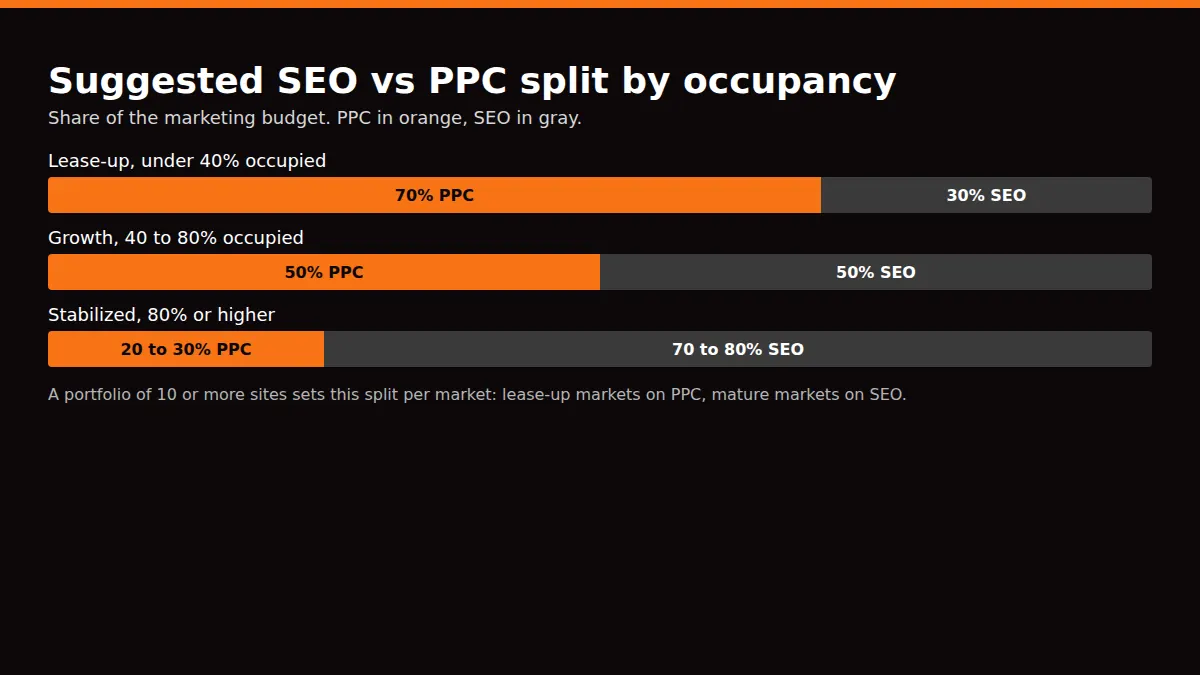
| Stage | Suggested split | Why |
|---|---|---|
| Lease-up (under 40% occupied) | 70% PPC / 30% SEO | Speed now, foundation for later |
| Growth (40 to 80%) | 50% / 50% | SEO starts carrying; ads fill gaps |
| Stabilized (80% or higher) | 20 to 30% PPC / 70 to 80% SEO | Margin protection; ads for brand defense and promos |
| Portfolio (10 or more sites) | Per-market splits | Lease-up markets on PPC, mature markets on SEO |
Three operator scenarios
Scenario 1: a new 500-unit facility at 22% occupancy. All-PPC would fill units at a high cost per move-in. All-SEO would fill them next year. The 70/30 lease-up split buys immediate move-ins while location pages, the Google Business Profile, and reviews build toward owned demand.
Scenario 2: a stabilized facility at 90% occupancy spending heavily on ads each month. Shifting 60% of that budget into SEO over two quarters is meant to hold move-ins steady while cutting the effective cost per lead, because rankings, once earned, do not bill you per click.
Scenario 3: a 12-site portfolio with mixed markets. Three lease-up sites run PPC-heavy. Nine stabilized sites run SEO-heavy with brand-defense ads only. Reporting tracks cost per move-in by site and channel, so budget moves as each market fills. Named examples of that kind of shift are on the case studies page.
The transition plan: PPC to SEO without losing move-ins
- Instrument first. Call tracking and move-in attribution by channel, before any budget moves. The setup is in call tracking for storage.
- Baseline 90 days. Know the true cost per move-in per channel before shifting a dollar.
- Move 10 to 20% of budget per month from PPC to SEO, and watch total move-ins weekly.
- Hold the PPC floor. Keep brand defense and the top-converting ad groups running.
- Review quarterly. When organic cost per move-in beats paid for two consecutive quarters, shift again.
Want the channel math run for your facilities? Book a strategy call and bring the ad spend. You can also send the last 90 days through the contact form.
Frequently asked questions
Is SEO or PPC better for self storage?
They solve different problems. PPC delivers move-ins immediately and charges you for as long as the ads run. SEO takes months to build and then produces move-ins at a falling cost per lead. Lease-up facilities lean PPC. Stabilized facilities lean SEO. Most run a deliberate mix of both.
How much should a storage facility spend on SEO vs PPC?
Published plans on this site run $999 a month in a low-competition market, $1,599 in a mid-competition market, and $2,449 in a high-competition market. PPC budget depends on your market's click costs. As a split: roughly 70% PPC during lease-up, 50/50 while growing, and 70 to 80% SEO once stabilized. Always decide using cost per move-in, not impressions.
How long until SEO beats PPC on cost per move-in?
In a typical suburban market, plan on visible ranking movement at 3 to 4 months and meaningful lead flow at 5 to 6 months. Most facilities see organic cost per move-in cross below paid somewhere between months 6 and 12 of consistent SEO work. Low-competition towns can move faster. REIT-dense suburbs take longer.
Is SpareFoot a PPC channel?
Functionally yes. You pay per move-in or referral, you build no owned asset, and the demand stops when the relationship ends. Treat aggregator spend as part of your paid budget and compare its cost per move-in directly against Google Ads and SEO when allocating budget.
Do Google AI Overviews hurt storage PPC?
They change where some clicks go. Pew Research Center found that when an AI Overview appears, users click a traditional result in 8% of visits, versus 15% without one (July 2025). Storage's highest-intent queries, "storage units [city]" and "storage near me," still show ads and the Map Pack, which is where PPC budgets are safest. Informational queries are the exposed ones.
Can I pause PPC once my SEO rankings are strong?
Partially. Most stabilized facilities can cut PPC to brand defense and promotional bursts once organic and Map Pack positions hold. Keep a floor: competitors bid on your name, and ads protect high-value searches during rate-increase periods or seasonal dips. A full shutdown is rarely the right move.
A worked example (illustrative numbers)
A simplified single-facility comparison, using round figures. These are illustrations, not a rate card. Plug in your own numbers from call tracking.
| PPC-heavy year | SEO-heavy year (after ramp) | |
|---|---|---|
| Monthly channel spend | $1,500 ads + $500 management | $899 SEO package |
| Monthly move-ins attributed | 12 | 10 |
| Cost per move-in | about $167 | about $90 |
| What happens if you stop paying | Move-ins stop next month | Rankings decay slowly over months |
Two things sit in that table. SEO's advantage is structural: once rankings exist, the next move-in costs very little, so the gap widens every quarter. PPC's advantage is also structural: it works this month, at full strength, with no ramp. A lease-up facility that picks the SEO column because it prefers the philosophy, and ignores the empty units this month, pays for that choice in occupancy. The numbers are illustrative. The shape of the trade-off is the point.

LSA vs standard Google Ads for storage
Local Services Ads (the Google Guaranteed and Google Screened listings above regular ads) behave differently from standard Google Ads. Treat them as a separate line:
- You pay per lead, not per click. The economics are better when lead quality holds, and worse when spam calls eat the budget.
- Reviews feed ranking directly. LSA position leans on the Google review profile, which makes review generation part of the ads plan. The reply side of that profile is self storage reputation management.
- Fewer levers than a standard campaign, and fewer ways to misconfigure one. For a single facility without an ads manager, LSA is often the safer paid entry point.
Standard search campaigns still win when you need tight control over keywords, negatives, and landing pages, especially for unit-type terms like "climate controlled" or "RV storage."
How AI is changing both channels
The line between the channels is less clean than it was. On the paid side, Google's Performance Max hands targeting and bidding to the system. It works when conversion data is clean, and it wastes money when it is not. On the organic side, AI Overviews sit above traditional results on many informational queries, which pushes SEO toward answer-shaped content and citations. That organic side is covered in generative engine optimization for self storage, and the paid-and-organic mix is part of AI marketing for self storage. Google's own note on how those summaries are generated is in AI features in Search.
Both channels increasingly reward the same inputs: strong reviews, clear content, and clean conversion tracking. Build those once and let both channels use them. Desk tools that have to match the listing are covered under AI for self storage.
Five budget mistakes operators make
- Judging PPC by clicks. Clicks are a cost, not a result. Move-ins per dollar is the paid metric that changes a budget.
- Stopping SEO at month four. In a typical suburban market, visible movement shows up around 3 to 4 months and lead flow around 5 to 6. Cutting the work in month four lands before that window.
- Running ads to the homepage. Paid clicks should land on the unit or location page that matches the query.
- Leaving SpareFoot out of the channel math. Aggregator fees are paid spend. Count them when comparing channels.
- No transition rule. "We will shift budget when SEO works," with no definition of "works," means the shift never happens.
How SEO and PPC work better together
The channels do more when they share one measurement system:
- PPC data informs SEO. Ad query reports show which terms turn into calls and reservations. Those terms become the SEO page targets.
- SEO can lower PPC costs. Strong landing pages and reviews improve Quality Score, which can reduce cost per click on the same terms.
- SERP coverage stacks. Owning the ad slot, the Map Pack slot, and an organic slot for "storage units [city]" leaves fewer openings for a competitor on that screen.
- PPC covers the months while a new location page climbs. When the page ranks, you cut that ad. That is the transition plan in reverse.
- Remarketing closes the loop. Organic visitors who did not reserve see ads later. Ad clickers who did not convert find the reviews and the Google Business Profile on the next search.
The decision checklist
Five questions, and the split follows from the answers:
| Question | If yes | If no |
|---|---|---|
| Do you need move-ins this month? | Weight PPC | SEO can carry more |
| Is occupancy above 80%? | Shift toward SEO | Stay blended |
| Are competitors bidding on your name? | Keep brand ads always | Optional |
| Is your cost per move-in rising year over year on ads? | Accelerate the SEO shift | Maintain current split |
| Can you commit to 6 or more months of consistent SEO work? | SEO pays back | Stay PPC-heavy until you can |
Re-run the checklist quarterly. Occupancy, competition, and AI search all move, so the mix has to move with them. The people who run that review with clients are on the about page.
Where the SEO-vs-PPC balance goes next
Two forces keep moving this split. AI search takes informational clicks from both channels. Organic CTR falls when an AI Overview appears, from 15% of visits to 8% in Pew's July 2025 study, which pushes value toward the queries those summaries do not cover: high-intent local searches where the Map Pack and local ads still dominate. "Storage near me" is that kind of query. Attribution is the second force. Call tracking and move-in reporting make channel economics clearer each year, and they show how much spend sits in awareness that never produced a rental. The operators who do well over the next few years will re-answer the split with their own cost per move-in every quarter.
The questions operators ask us before rebalancing
The same practical questions come up in these conversations. How fast can ads be cut safely? Usually 10 to 20% of budget per month while watching total move-ins. Faster than that, and you cannot tell which change caused what. Should both channels target the same keywords? High-intent money terms, yes, so you can own more of the results page. Informational terms, no: let the organic page do that work alone. Does seasonality change the split? College markets, military towns, and snowbird regions should lean into PPC four to six weeks before the demand spike, then let SEO carry the off-season. What if only one channel fits the budget? Under 60% occupancy, PPC keeps units moving. Over 80%, SEO is the channel worth funding for the long run. For our own facility we would run both, sequenced by stage, measured by move-ins, and adjusted every quarter.
The one-paragraph summary
Rent demand when speed matters. Own it when margins matter. PPC is the right tool for lease-up, seasonal spikes, and brand defense. SEO is the right tool for the demand you want to stop paying for twice. The measurement that referees the budget is cost per move-in.
Pull the last 90 days of spend and move-ins by channel, calculate the real cost per move-in for each, and write the numbers down. The splits on this page get easier to choose once those two numbers are on paper.
Own your demand; rent it only when you have to
SEO vs PPC for self storage is a budget allocation that should change as occupancy changes. We build the SEO side of that equation as a self storage SEO agency, and we will say when ads are the better buy this quarter.
Book a strategy call and we will model cost per move-in by channel, then show the split we would run.