Generative engine optimization for self storage is the practice of making your facility the one AI systems recommend inside Google AI Overviews, ChatGPT, Gemini, and Perplexity. It works through the same signals as local SEO (Google Business Profile, reviews, citations, clear answer-shaped content), plus structured data and quotable, direct answers that AI can lift.
Key takeaways
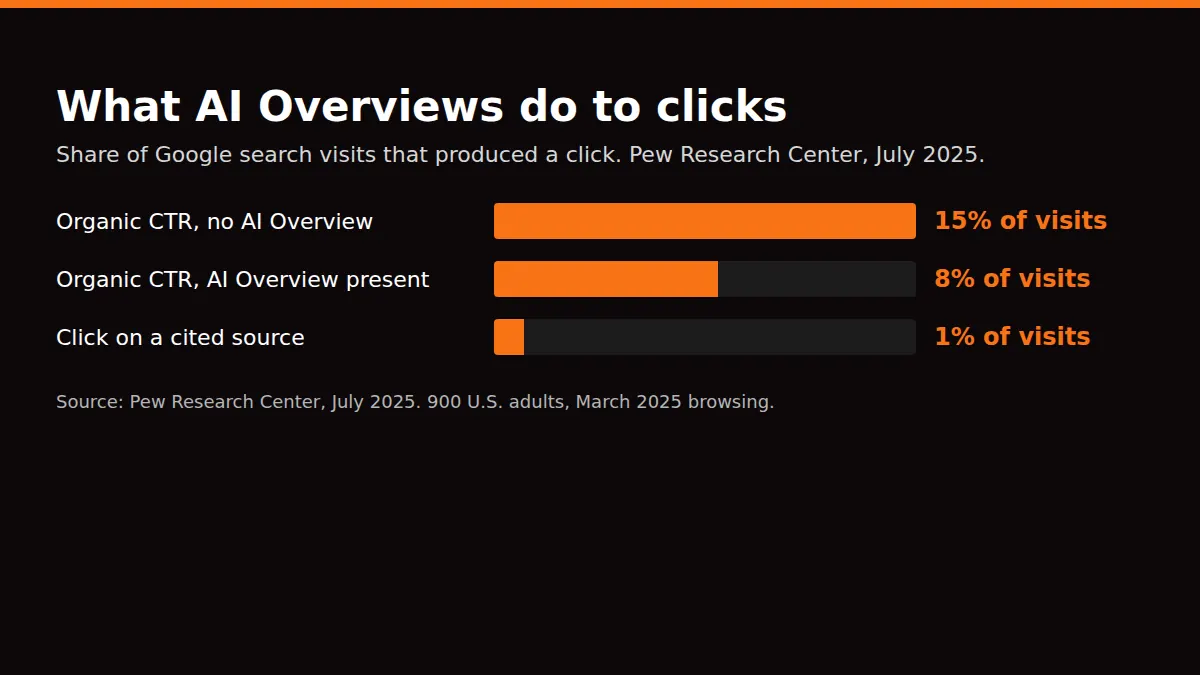
- When an AI Overview appears, users click organic results about half as often: 8% of visits versus 15% without one (Pew Research Center, July 2025). The click is moving inside the AI answer. Just 1% of those visits produce a click on a source cited inside the overview.
- Semrush found the average AI search visitor converted at 4.4 times the rate of a traditional organic visitor, based on conversion rate in its 2025 study of digital marketing topics (Semrush, July 2025). That study covered marketing topics, so treat 4.4x as a benchmark to test against your own move-ins, not a storage forecast.
- For local queries like "storage near me," AI recommendations lean on your GBP, reviews, and citations, the assets you already build for the Map Pack.
- GEO sits on top of local SEO. Start with our self storage SEO guide if the foundation is not done.
In this guide: What GEO is · Why storage can't ignore it · How AI picks facilities · The 7-step GEO playbook · Platform by platform · Measuring AI visibility · FAQ
Updated: November 2026. Published by the SEO for Self Storage team.
What is generative engine optimization for self storage?
Generative engine optimization (GEO) is the work of getting your business cited and recommended inside AI-generated answers. For a self storage operator, that means when a renter asks ChatGPT "where should I rent a storage unit in Plano" or Google shows an AI Overview for "climate controlled storage near me," your facility is named in the answer. The blue links can still sit underneath it.
Traditional SEO fights for a click from a list of ten links. GEO fights to be the answer itself. Both matter, and the balance is shifting fast. Google documents how AI features in Search generate summaries and cite pages from the index. Your pages still have to be crawlable, clear, and specific enough for that summary to name the facility.
Why storage operators can't ignore AI answers
Pew Research Center found that when a Google search shows an AI Overview, users click a traditional result in only 8% of visits, versus 15% on pages without one, and just 1% of visits produce a click on a source cited inside the AI Overview itself.
For storage, this is a local game. "Storage near me" queries are answered from local inventory, meaning GBP listings, reviews, and local citations, the same signals that decide the Map Pack. If your Google Business Profile optimization and review generation are strong, you are already halfway to AI visibility. If they are weak, AI answers will recommend the REIT down the road.
That local work is self storage SEO. The AI layer does not get its own budget until the profile, the reviews, and the citations are in order.
How AI engines pick which facilities to recommend
AI systems assemble local recommendations from a predictable set of signals:
- Google Business Profile data: categories, services, photos, and completeness.
- Reviews: count, recency, rating, and the words reviewers use ("climate controlled," "secure," "easy move-in").
- Citations and listings: consistent name, address, and phone across directories, including industry platforms like SpareFoot.
- Answer-shaped content: pages that directly answer the question asked, in plain language, near the top.
- Structured data: LocalBusiness and SelfStorage schema that tells machines exactly what you are and where. See schema markup for self storage.
- Third-party mentions: local press, industry sites, and community pages that corroborate you exist and matter.

Reputation platforms already sell tracking for how often ChatGPT, Gemini, and Perplexity name a business. You can run the same check yourself once a month, which is the method in the measurement section below. No vendor login is required for that monthly check.
The 7-step GEO playbook for storage facilities
- Lock your local foundation. Complete GBP categories, services, photos, and Q&A for every facility. AI engines treat GBP as ground truth for local recommendations.
- Run review generation on autopilot. Fresh reviews mentioning your unit types and amenities give AI quotable, current proof. The workflow is in self storage review generation, and the reply side sits with self storage reputation management.
- Clean your citations. One name, address, and phone format everywhere, including SpareFoot and industry directories.
- Answer questions directly on your pages. Put a 40 to 60 word plain-English answer under every key heading, such as "How much does a 10x10 cost in [city]?" and "Do you offer climate controlled units?" AI lifts exactly this kind of text.
- Add and validate schema. SelfStorage and LocalBusiness markup with your address, geo, amenities, and price range.
- Publish quotable facts. Facility statistics, unit size guides, and local moving data that AI engines can cite, using the same approach as our linkable assets strategy.
- Monitor and iterate monthly. Ask ChatGPT, Gemini, and Perplexity your market's renter questions and log who is recommended. Until the dedicated platform guides are live, use local SEO for a self storage facility for the Map Pack inputs and the Google Business Profile guide for storage for the listing fields AI engines read.
| Signal | Traditional local SEO | AI search (GEO) | Owner action |
|---|---|---|---|
| GBP completeness | Map Pack ranking | Ground truth for AI answers | Complete every field |
| Reviews | Ranking and conversion | Quotable proof for AI | Automate requests |
| Citations | Consistency signal | Entity confirmation | Clean NAP everywhere |
| Content | Ranks pages | Gets lifted into answers | Answer-first structure |
| Schema | Rich results | Machine-readable identity | LocalBusiness markup |
| Brand mentions | Link authority | Corroboration | Local PR and partnerships |
Platform by platform
| Platform | How it sources local answers | Strongest move |
|---|---|---|
| Google AI Overviews | Google's index, plus GBP and reviews | Strong local SEO plus answer-first content |
| ChatGPT | Web sources, citations, and brand mentions | Consistent entity data and quotable pages |
| Gemini | Google ecosystem | GBP completeness and review velocity |
| Perplexity | Live web retrieval with citations | Well-structured, fact-dense pages |
Three operator scenarios
Scenario 1: a 350-unit facility, strong Map Pack, zero AI presence. The site ranks but has no answer-shaped content. We add direct-answer blocks to its location and unit pages, validate schema, and within a quarter it starts appearing in AI Overviews for "climate controlled storage [city]," a query where the AI answer sits above its number 1 organic listing.
Scenario 2: a five-site operator losing to a REIT in ChatGPT answers. The REIT wins on citations and review volume, not on a nicer website. We run a review velocity program and citation cleanup across all five sites. ChatGPT recommendations begin including the independent brand within two review cycles.
Scenario 3: a lease-up facility in a new market. No reviews, no citations, no history. We sequence GBP setup, directory listings, and answer-first location pages before opening, so AI engines have something to recommend the day the doors open. The same sequence is the core of AI for self storage when the software on the desk has to match what the listing says.
Measuring AI visibility without a marketing team
Once a month, run your market's five highest-intent renter questions through ChatGPT, Gemini, Perplexity, and Google, checking for AI Overviews. Log whether you are cited, who is cited instead, and what source the AI names. That log is your AI share of voice. Track it the way you track rankings. How a cited visit becomes a signed lease is covered in how SEO fills storage units, and our case studies show how visibility metrics connect to actual rentals.
Want to know if AI recommends your facility today? Book a strategy call and we will run the check live on the call. You can also send the questions through the contact form if a live call is a bad week.
Frequently asked questions
What is generative engine optimization for self storage?
It's the practice of getting your storage facility cited and recommended inside AI-generated answers: Google AI Overviews, ChatGPT, Gemini, and Perplexity. It builds on local SEO signals (GBP, reviews, citations) plus answer-shaped content and schema markup that AI systems can quote directly.
Is GEO replacing SEO for storage facilities?
No. GEO sits on top of local SEO. The same assets that rank you in the Map Pack, a complete GBP, fresh reviews, and consistent citations, are the primary sources AI engines use for local recommendations. Weak local SEO means no AI visibility. Strong local SEO is the foundation GEO builds on.
How do AI Overviews affect my storage facility's traffic?
When an AI Overview appears, organic clicks drop by roughly half, from 15% of visits to 8% (Pew Research Center, 2025). Just 1% of those visits produce a click on a source cited inside the overview. The goal shifts from ranking below the answer to being named inside it.
Do I need different content for AI search than for Google?
Use the same pages, with clearer structure. AI systems lift direct, plain-English answers placed immediately under question-style headings. Pages that bury answers in long paragraphs get skipped. Add a 40 to 60 word direct answer under each key heading and keep the rest of your content as is.
How can I tell if ChatGPT recommends my facility?
Ask it. Once a month, run your market's real renter questions ("best storage in [city]," "climate controlled storage near [landmark]") through ChatGPT, Gemini, and Perplexity. Log who gets named and which sources are cited. That log is your AI visibility baseline and your progress tracker.
How long does GEO take to show results for storage?
The local-signal work, GBP completion, citation cleanup, and schema, can shift AI answers within weeks because AI engines refresh local data frequently. Review-driven improvements take a few months of steady generation. The timeline matches local SEO, because the same inputs power both.
What GEO can't do (the honest limits)
Generative engine optimization has boundaries worth knowing before you spend:
- It can't fix a weak reputation. AI engines read your reviews. No content structure overcomes a 3.6-star profile. Fix review generation first.
- It can't guarantee citations. AI answers are probabilistic. The same question can produce different answers on different days. You optimize inputs, not outputs.
- It can't replace the Map Pack. For "storage near me," the Map Pack still captures the highest-intent clicks. GEO adds a layer on top of local SEO. The map-pack work is in Google Maps ranking for storage.
- It can't work in a week. Review velocity, citation cleanup, and content indexing take weeks to months. Vendors promising instant AI visibility are selling screenshots.
- It can't be measured as precisely as rankings. AI visibility tracking is a monthly sampling exercise. Treat the log as directional.
GEO vs SEO vs paid: where this fits in your budget
Think of GEO as a multiplier on your SEO spend, not a new line item. The work, GBP completion, reviews, answer-first content, and schema, is the same work a good local SEO program already does. GEO structures it so AI engines can use it. If you are choosing between funding a GEO layer and fixing foundational local SEO, fund the foundation first. The channel math for search versus ads is in marketing for storage facilities, and the price ranges for the foundation work are in the self storage SEO cost breakdown. GEO earns its own attention in markets where AI Overviews already appear for your unit-type searches, and in portfolios where a single content system can lift AI visibility across every location at once.
Entity consistency: the unglamorous core of AI visibility
AI engines build a picture of your facility from every place your name appears. When your GBP says "SecureStor Mini Storage," your website says "SecureStor Storage," and SpareFoot says "Secure Stor," the engine sees ambiguity, and ambiguous entities do not get confidently recommended. The audit is simple: list every place your facility is named (GBP, website, SpareFoot, Yelp, Facebook, directories, and your FMS-powered listings) and make the name, address, phone, and unit offer identical everywhere. Then keep them identical as things change. It is boring work, and it is the GEO task with the most effect after reviews. Our citation building for self storage guide covers the directory side of this cleanup. The people who run that cleanup for clients are on the about page.
A sample AI visibility log
The monthly tracking table we use with clients. Copy this format:
| Date | Engine | Query | Cited? | Who is cited instead | Source named |
|---|---|---|---|---|---|
| Nov 2026 | ChatGPT | best storage in [city] | No | Competitor A | SpareFoot |
| Nov 2026 | AI Overview | climate controlled storage [city] | Yes | None | Our unit page |
| Nov 2026 | Gemini | RV storage near [landmark] | No | REIT | GBP listing |
| Nov 2026 | Perplexity | cheap storage units [city] | Yes | None | Our rates page |
Four months of this log tells you more about your AI visibility than a one-time check: which engines ignore you, which queries you are winning, and whether the trend is moving the right way as your review and content work compounds.
GEO for multi-location portfolios
Portfolio operators get a scale advantage a single-site owner does not: one content system, many locations. The portfolio GEO playbook has three rules:
- Standardize the entity layer first. Every location's GBP, citations, and schema should follow identical formatting conventions. Inconsistency across forty locations compounds into machine confusion at scale.
- Build answer blocks once, then localize each site. The 40 to 60 word answers under key headings can follow one template with local variables (city, unit mix, amenities) as long as each location's details are genuinely its own. Fully duplicated answer blocks across sites teach AI engines to trust none of them.
- Track AI visibility per market, not in aggregate. A portfolio average hides the markets where competitors get cited. The monthly log should run per facility, with underperforming markets getting the next content and review pushes.
Done right, a portfolio's GEO cost per location drops as the system matures. It is one of the few marketing channels where scale helps the independent operator against the REITs.
The content formats AI engines quote most
Across the AI answers we monitor for storage clients, the formats that get lifted repeatedly are:
- Direct definitional answers: one or two sentences answering the question outright, right under a question-style heading.
- Structured comparisons: tables comparing options (covered versus uncovered storage, unit sizes) with clear labels.
- Numbered processes: "how move-in works here" as explicit steps.
- Specific, sourced facts: statistics with a named source and year. AI engines prefer citable claims over adjectives.
- Consistent entity statements: the same description of who you are and what you offer, repeated identically across your site, GBP, and directories.
Clever copy is not on that list. AI engines quote clarity. Write for the renter first, and structure the page so a machine can lift the answer. The two line up once the answer sits in the first sentences under the heading, not in the third paragraph.
Where GEO goes next
AI answers will get more local and more transactional. Expect AI engines to quote live pricing and availability within answers, to compare facilities against each other in a single response, and to pull deeper from review text when justifying recommendations. The facilities positioned for that world are the ones doing the unglamorous work now: complete and consistent entity data, a steady stream of fresh reviews, and pages that answer questions in plain, quotable language. GEO in 2026 is early enough that most competitors in a given market have not started. Local SEO had a similar window a decade ago, and that window closed once the Map Pack filled up.
The operator's one-paragraph summary
AI visibility is local SEO with two extra habits. The facilities AI recommends are the ones with complete Google Business Profiles, fresh reviews, consistent citations, and pages that answer renter questions in plain language, the same facilities that win the Map Pack. GEO adds structure so machines can quote those answers, and a monthly check of whether they actually do. Start there and measure the log against move-ins.
Be the facility AI recommends
Generative engine optimization for self storage is your local SEO, reviews, and content, sharpened so machines can quote them. We build it on top of every self storage SEO services engagement, and as part of AI marketing for self storage.
Book a strategy call and we will check your AI visibility live, then show you the 90-day plan to own it.