
AI marketing for self storage is the use of AI to plan, produce, and optimize your marketing: drafting location pages and ads, running Google Performance Max and Meta Advantage+ campaigns, nurturing leads by email and SMS, and getting your facility recommended inside ChatGPT and Google AI Overviews. Done right, it cuts cost per move-in — not corners.
Key takeaways
- Renters increasingly ask ChatGPT, Gemini, and AI Overviews where to store. Visibility there is now a marketing channel, and it runs on the same signals as local SEO.
- AI produces first drafts in minutes; humans add local proof and expertise. Publish raw AI output and Google will eventually ignore it.
- The honest comparison isn't "AI vs agency" — it's which tasks AI executes and which decisions stay human.
- Measure cost per move-in by channel. Everything else is decoration.
- AI marketing compounds with operations AI: the facility that answers instantly and shows up in AI search wins twice. See our AI for self storage service for the operations side.
In this guide: What AI marketing covers · Who it's for · The services, channel by channel · AI vs agency: the honest math · What it costs · How we work · Deliverables · FAQ
Updated November 2026. Written by the SEO for Self Storage Team — self storage SEO services.
What AI marketing for self storage covers
AI marketing for self storage means using AI tools to execute marketing work faster and cheaper, while humans keep control of strategy, brand, and compliance. That includes AI-assisted content and SEO, paid ads run by Google's and Meta's AI, automated email and SMS nurture, and the newest channel: making sure AI assistants recommend your facility when renters ask where to store.
It is not autopilot. Modern Storage Media describes AI in storage marketing as a force multiplier: it speeds drafts and analysis, and people still own judgment, brand, and strategy. The same piece says the operators who do well treat AI as a starting point, not a finished page.
Who this service is for
- Independent operators doing marketing themselves at 9 p.m. who need leverage, not another tool subscription.
- Multi-facility operators whose marketing can't keep pace with location count — new pages, new promos, new markets.
- Portfolios paying agency retainers who suspect half the invoice is work AI now does better and faster.
If your foundation is weak — no rankings, no reviews, a slow website — start with our self storage SEO work first, then layer AI on top. AI scales whatever exists, including dysfunction. The Self Storage Association is the trade group for operators comparing how facilities are run and marketed.
The services, channel by channel
1. AI content that actually ranks
We use AI for research, briefs, and first drafts, then add the things AI can't invent: your real occupancy patterns, your market's quirks, your tenants' actual questions. Raw AI text published unchanged is how sites lose rankings. Google's helpful content guidance says pages should be made for people and show real experience, not mass-produced text. Our live notes on that standard are self storage content marketing and self storage SEO best practices.
2. AI SEO workflows
Keyword clustering, content briefs, internal-link suggestions, meta variations — the hours-eating parts of SEO, done in minutes with human review. The full order of that work is the self storage SEO complete guide.
3. Visibility in ChatGPT, Gemini, and AI Overviews
This is the channel almost nobody is working yet. When a renter asks an AI assistant where to store nearby, the answer leans on citations, consistent business data, fresh reviews, and clear, answer-shaped content. Treat any vendor's ranking or move-in claims as that vendor's marketing, not as your forecast. The live starting points are local SEO for a self storage facility and a complete Google Business Profile for a storage facility.
4. AI-run paid ads
Google describes Performance Max as a campaign that uses Google AI across Search, YouTube, Display, Discover, Gmail, and Maps. You set the conversion goals, and the controls include negative keywords, brand exclusions, and a budget. For a storage account those controls are the fence: clean conversion data, and a stop on queries that are not move-ins. Left alone, an automated campaign will spend on junk. The wider channel mix is in marketing for storage facilities, and the on-site result of an ad click is conversion work on a storage website.
5. AI email and SMS nurture
Behavior-triggered sequences for new inquiries, upcoming move-ins, and move-outs, including review requests, written once and personalized per facility. The review half of that routine is review generation for a storage facility. The page habits that keep the message specific are in on-page SEO for storage websites.
6. Measurement: cost per move-in, not vanity metrics
Every channel gets tied to signed leases. If AI-assisted ads or content can't show attributed move-ins, we cut them. How a search visit becomes a lease is covered in how SEO fills storage units.
| Channel | What AI does | What humans still own |
|---|---|---|
| Content and SEO | Research, briefs, drafts, clustering | Local expertise, final edit, E-E-A-T |
| AI search visibility | Answer-shaped formatting, citation tracking | Review generation, entity consistency |
| Google / Meta ads | Bidding, targeting, budget pacing | Conversion data quality, creative direction, guardrails |
| Email and SMS | Timing, personalization, drafting | Offers, tone, compliance |
| Reporting | Dashboards, anomaly flags | Budget decisions, strategy |
Three operator scenarios
Scenario 1: a single 300-unit facility, owner does everything. We set up an AI content workflow (two location-support pages per month), an AI review-response routine, and a GBP posting schedule using the same weekly rhythm as marketing for storage facilities. Owner time drops from six hours a week to ninety minutes of review.
Scenario 2: a six-site regional chain stuck at 78% occupancy. We rebuild location pages with AI-assisted drafts plus local proof, launch fenced Performance Max campaigns per market, and measure cost per move-in against their old agency retainer. The hybrid model is judged on that cost, not on a vendor's comparison table.
Scenario 3: a 20-location portfolio losing Map Pack ground to REITs. We run portfolio-wide AI content refreshes, standardize review generation feeding the reputation management for a storage facility work, and track AI-search visibility across ChatGPT and AI Overviews for every market.

AI vs agency: the honest math
| DIY with AI tools | Traditional agency | Our hybrid model | |
|---|---|---|---|
| Monthly cost | Tool subscriptions plus your hours | A monthly retainer | Scoped to portfolio size |
| Speed | Fast drafts, slow strategy | Slow drafts, real strategy | Fast execution, human strategy |
| Local storage expertise | None unless you have it | Varies widely | Storage-only, always |
| AI-search visibility | DIY possible, rarely done | Most agencies don't offer it | Core deliverable |
| Accountability | You | A monthly report | Cost per move-in, attributed |
When an agency retainer and an in-house stack are both on the table, compare them the way marketing for storage facilities compares channels: what filled a unit, and what it cost.
What it costs
No fixed packages, because portfolios differ. Cost drivers: number of facilities, current content and review baseline, ad spend under management, and whether we're layering AI onto an existing SEO engagement or starting fresh. What's constant: you see cost per move-in by channel, every month, and we cut what doesn't produce. How a search engagement is scoped is in self storage SEO cost.
Want the hybrid model scoped to your portfolio? Book a strategy call and we'll show you exactly which tasks AI takes off your plate.
How we work
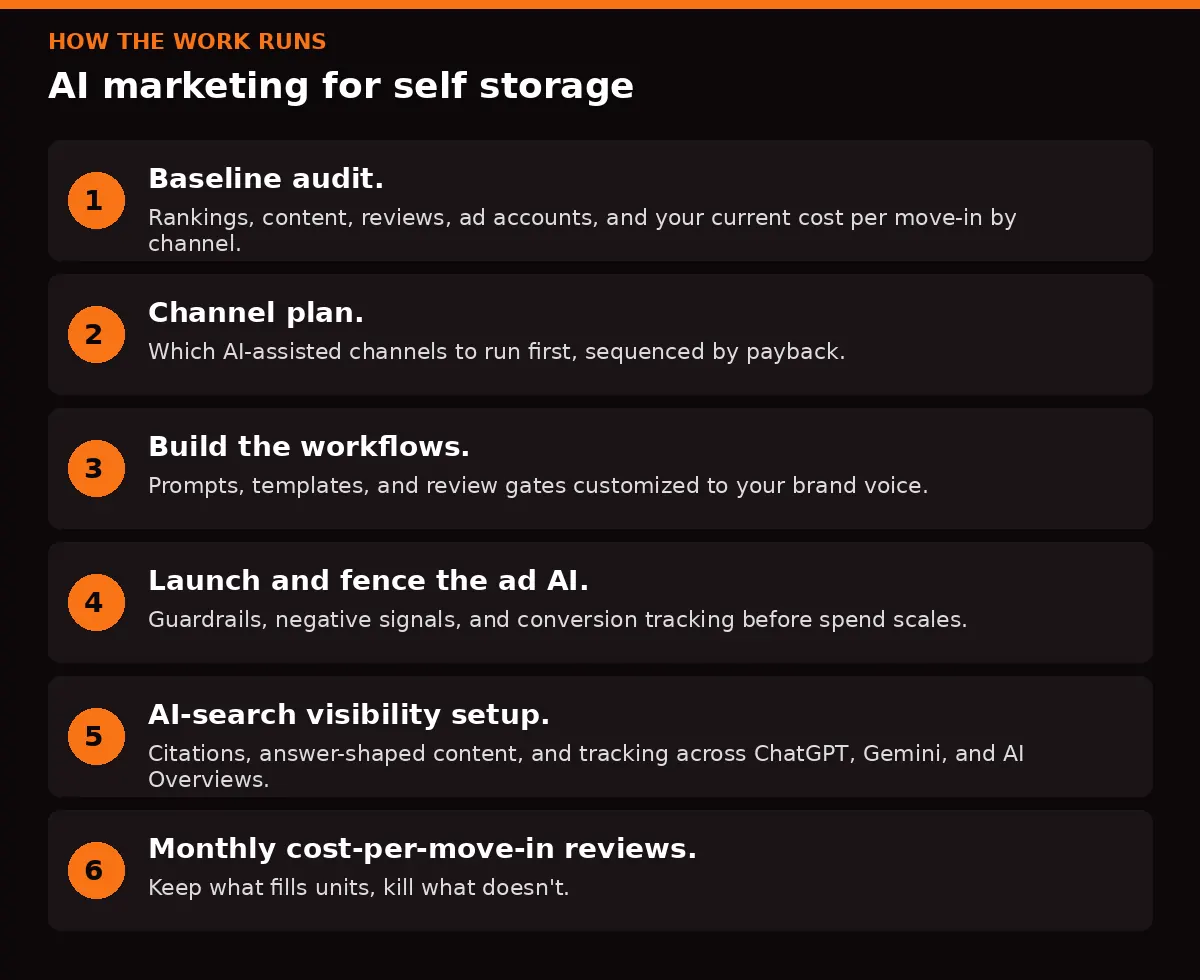
- Baseline audit. Rankings, content, reviews, ad accounts, and your current cost per move-in by channel.
- Channel plan. Which AI-assisted channels to run first, sequenced by payback.
- Build the workflows. Prompts, templates, and review gates customized to your brand voice.
- Launch and fence the ad AI. Guardrails, negative signals, and conversion tracking before spend scales.
- AI-search visibility setup. Citations, answer-shaped content, and tracking across ChatGPT, Gemini, and AI Overviews.
- Monthly cost-per-move-in reviews. Keep what fills units, kill what doesn't.
What you get (deliverables)
- A channel-by-channel AI marketing plan with 90-day sequencing
- AI content workflow with human-review gates and an E-E-A-T checklist
- Managed Performance Max / Advantage+ campaigns with guardrails
- AI-search visibility setup and monthly tracking
- Email/SMS nurture sequences per facility
- A prompt and workflow library your team keeps, built on the same page rules as on-page SEO for storage websites
- Monthly reporting in cost per move-in — the same discipline you'll see across our case study work
Why operators hire SEO for Self Storage
Storage is all we do. We know what ECRI does to churn, why a 10x10 climate-controlled unit ranks differently than parking, and how SpareFoot economics distort your channel mix. AI tools are generic; the strategy that points them isn't. As an SEO for Self Storage company first, we build AI marketing on top of rankings, reviews, and local authority that compound — not on rented attention. Who does the work is on the about page.
Frequently asked questions
Is AI marketing for self storage just ChatGPT writing my blog?
No. ChatGPT drafts are one input. Real AI marketing covers AI-assisted content with human review, AI-run ad campaigns with guardrails, automated email and SMS nurture, and visibility inside AI assistants like ChatGPT and Google AI Overviews — all measured in cost per move-in, not word count.
Will Google penalize AI-generated content on my storage site?
Google penalizes unhelpful content, not AI content specifically. Raw, unedited AI text tends to be thin and generic, which is what gets filtered. Content that combines AI drafting with real local expertise, original data, and proper E-E-A-T signals continues to rank — that's the workflow we run for every client.
How do I get my facility recommended by ChatGPT or AI Overviews?
AI assistants pull from consistent business listings, strong recent reviews, clear answer-shaped content, and third-party citations. We optimize all four: citation cleanup, review generation, FAQ-style content that directly answers renter questions, and tracking of how often AI engines actually cite your facility.
Is AI marketing cheaper than an agency?
Usually, but the saving is in execution, not strategy. AI cuts the cost of drafts, ad management, and reporting dramatically. What you still pay for is judgment: positioning, budget allocation, and brand. A hybrid model — AI execution plus human strategy — typically costs less than a traditional retainer with more output.
What results should I expect, and how fast?
Ads show data within weeks; content and AI-search visibility compound over months. Vendor-reported figures in this space claim meaningful move-in lifts within 60–90 days, but treat any projection skeptically. The only number that matters is your cost per move-in by channel — we report it monthly and cut what underperforms.
Do I need to change my website or software to use AI marketing?
No. AI marketing layers onto your existing site, whether that's a custom build, a Storable website, or a storEDGE template. Content, ads, email, and AI-search optimization all work within your current stack. If something technical blocks results, we flag it with the fix, not a forced rebuild.
The AI marketing stack by budget
What a sensible AI marketing setup looks like at three levels of spend:
| Level | What's running | Who reviews it |
|---|---|---|
| Starter (single facility) | AI-drafted GBP posts, AI review-response drafts, one AI-assisted page per month | Owner, an hour a week |
| Growth (2–10 facilities) | Everything in Starter, plus fenced Performance Max campaigns, email/SMS nurture sequences, AI-search visibility tracking | Manager or agency partner, weekly |
| Portfolio (10+ facilities) | Everything above, plus programmatic location content with human gates, portfolio-wide AI visibility reporting, quarterly strategy reviews | Agency hybrid model |
The mistake at every level is buying the tier above your review capacity. AI output without review is just faster mediocrity. Scale the human review time first, then the tooling.
Five AI marketing mistakes we see operators make
- Publishing raw AI drafts. Unedited AI text reads like every other facility's site and tends to fail Google's helpful-content bar over time. The fix is a human pass that adds local specifics only you know, the same bar as self storage SEO best practices.
- Letting ad AI run unfenced. Performance Max without negative signals and conversion guardrails spends on junk queries and calls it learning. Fence first, spend second.
- Chasing AI visibility with a weak review profile. AI engines won't recommend a 3.8-star facility no matter how good the content is. Fix the inputs before optimizing the outputs.
- Buying tools before workflows. A stack of AI subscriptions with no weekly routine is shelfware. The routine comes first, in the same order as marketing for storage facilities.
- Measuring traffic instead of move-ins. AI makes it easy to produce volume; volume without attribution hides failure. Cost per move-in or it didn't happen.
What we measure every month
Each client dashboard answers five questions without interpretation gymnastics: How many move-ins came from each channel? What did each cost? Which AI-assisted assets produced them? Where did we show up in AI answers this month? And what do we cut or scale next month because of it? Any metric that doesn't change a decision gets removed from the report. That's the same discipline described in how SEO fills storage units, and it's why our reporting fits on one page.
The first 90 days of AI marketing, sequenced
Operators always ask what this looks like in practice. The honest sequence:
- Days 1–14: Baseline. Pull cost per move-in by channel, review counts, GBP health, and current AI visibility. Nothing changes yet — you're measuring what "before" looks like.
- Days 15–30: Quick wins. AI-assisted GBP posting schedule starts, review-response drafting goes live, and the first two AI-assisted content pages ship through human review.
- Days 31–60: Channel builds. Performance Max campaigns launch with guardrails, email/SMS nurture sequences go live for new inquiries, and citation cleanup feeds the AI-search layer.
- Days 61–90: Optimization. First full reporting cycle: which AI-assisted assets produced move-ins, what to scale, what to cut. The monthly rhythm from here is measure, adjust, repeat.
Notice what's not in the first month: anything irreversible. AI marketing done right starts with measurement and reversible moves, so a wrong bet costs a lesson, not a quarter's budget.
AI and your brand voice
The complaint about AI content — "it all sounds the same" — is really a complaint about unedited defaults. The fix is a voice document: a one-page guide covering how your company talks (direct or warm, funny or plain, what you never say), three examples of good existing copy, and the words your brand uses for things (we say "move-in," not "rental transaction"). Feed that document into every AI workflow, and drafts come out recognizably yours before human editing. It takes an afternoon to create and saves hours of rewriting every month. We build this into every engagement because it's the difference between AI that scales your voice and AI that erases it.
Where AI marketing goes next
The trajectory is clear: more of the execution stack automates, and the human share concentrates in strategy, brand, and compliance. Content volume stops being a constraint — meaning differentiation shifts entirely to what AI can't replicate: your market knowledge, your occupancy data, your facility's real story. AI-search visibility becomes a standard reporting line next to rankings, not a novelty. And the operators who win won't be the ones with the most AI tools — they'll be the ones with the clearest cost-per-move-in discipline, cutting what doesn't produce and scaling what does. The tools will keep changing; the measurement shouldn't.
The one-sentence test for any AI marketing activity
Before any AI-assisted task goes live, we apply one test: could a renter or a Google reviewer tell a machine made this, and would they care? A follow-up text that arrives instantly with the right unit price passes — nobody cares how fast a helpful message was drafted. A location page full of generic filler fails — renters and algorithms both smell it. Run every AI output through that filter and the technology becomes nearly risk-free: it handles the volume, humans guard the voice, and your marketing gets faster without getting cheaper-feeling. That's the whole philosophy — AI for throughput, humans for trust.
Stop paying agency prices for work AI does better
AI marketing for self storage fills units for less when strategy stays human and execution goes machine-fast. That's the model we run.
Book a strategy call and we'll map your first 90 days of AI marketing — channels, costs, and the cost-per-move-in targets we'll be judged on. You can also write from the contact page.