
Self storage reputation management is the operating system for a facility's public feedback: a steady flow of reviews from real tenants, a reply to every one within a set time, monitoring on Google, Yelp, and SpareFoot, and a path from each complaint to the person who fixes it. Done on a schedule, it lifts Map Pack rankings and the share of searchers who call.
Key takeaways
- In BrightLocal's 2025 Local Consumer Review Survey, 4% of consumers said they never read online business reviews. For a storage renter choosing between two facilities a mile apart, the reviews are often the difference.
- Review count, velocity, the words reviewers use, and owner responses all feed local rankings. Reputation management is local SEO.
- The FTC review rule, 16 CFR Part 465, took effect on October 21, 2024. It bans fake reviews and incentives tied to the sentiment of a review. The Federal Register final rule cites a maximum civil penalty of $51,744 per violation, and a court can impose less.
- The working target is a steady stream of honest reviews, answered on time, with the problems actually fixed.
- Ask every eligible tenant once, at the same point in the stay. Google's prohibited content rules ban paying for reviews and asking only the happy tenants.
On this page: Who this is for · What the service includes · How the system works · What it costs · Deliverables · Why us · FAQ
Updated November 2026. Written by the SEO for Self Storage Team. SEO for Self Storage is the rankings work this program sits on.
Who this is for
- Independent owners whose three closest competitors all have more Google reviews than they do.
- Multi-facility operators who cannot see review performance across sites, and who hear about problems on the regional manager's monthly call.
- Operators recovering from a review hit: a security incident, a rate-increase backlash, or a neglected profile sitting at 3.8.
Reputation work compounds with rankings. If the Map Pack position is the bottleneck, pair this with our self storage SEO agency program. If you want software drafting the first reply, see AI for self storage. The content and ads side of the same account is AI marketing for self storage.
What self storage reputation management includes
1. Review generation that runs on a schedule
We connect review requests to real events in the management software: a completed move-in, the first month completed, and move-out. The ask goes out by SMS and email when tenants are most likely to answer. One neutral ask to every eligible tenant. Cherry-picking happy customers is review gating. Google's rules prohibit selectively soliciting positive reviews, and the FTC rule bans incentives conditioned on sentiment. The live playbooks are self storage review generation and how to get more Google reviews for storage.
2. Response management
Every review gets an on-brand reply inside an agreed window. Positive reviews get a short, warm note. Negative reviews get a framework that acknowledges the complaint without admitting liability, and that never confirms account details in public. The closest live notes on replies and one-star reviews are in reputation management for a storage facility and the self storage reviews and reputation guide.
3. Monitoring and alerts
Google, Yelp, Facebook, and SpareFoot are watched at every location. New reviews trigger an alert. Anything that mentions security, injury, or a billing dispute follows an escalation rule. The monitoring habit sits next to the profile work in GBP optimization for self storage.
4. Fake review removal
We flag, document, and escalate reviews that violate platform policies: competitor attacks, ex-employee grudges, and reviews of the wrong business. Honest criticism stays up. The public record of how reviews show on a page is covered in review schema for a storage facility.
5. Multi-location governance
Brand-consistent responses, facility-level benchmarks, and a monthly report of review velocity, average rating, and response time per site. Portfolio search structure is in multi-location SEO for storage operators.
6. Software selection and management
If you already pay for a review tool, we run it. If you do not, we pick one only when someone will actually use the alerts. The buying decision is separate from the operating system on this page. How we scope related search work is in self storage SEO cost.
| Component | What it does | What it moves |
|---|---|---|
| Automated requests | Ask every eligible tenant once, after move-in or move-out | Review volume and velocity |
| Response management | On-brand replies within the SLA | Conversion and ranking signals |
| Monitoring and alerts | Catch every review across platforms and sites | Response time |
| Fake review removal | Flag and escalate policy violations | Rating integrity |
| Portfolio governance | Benchmarks, SLAs, and brand voice per facility | Consistency at scale |
| Reporting | Velocity, rating, response time, and sentiment per site | Accountability |
How the system works
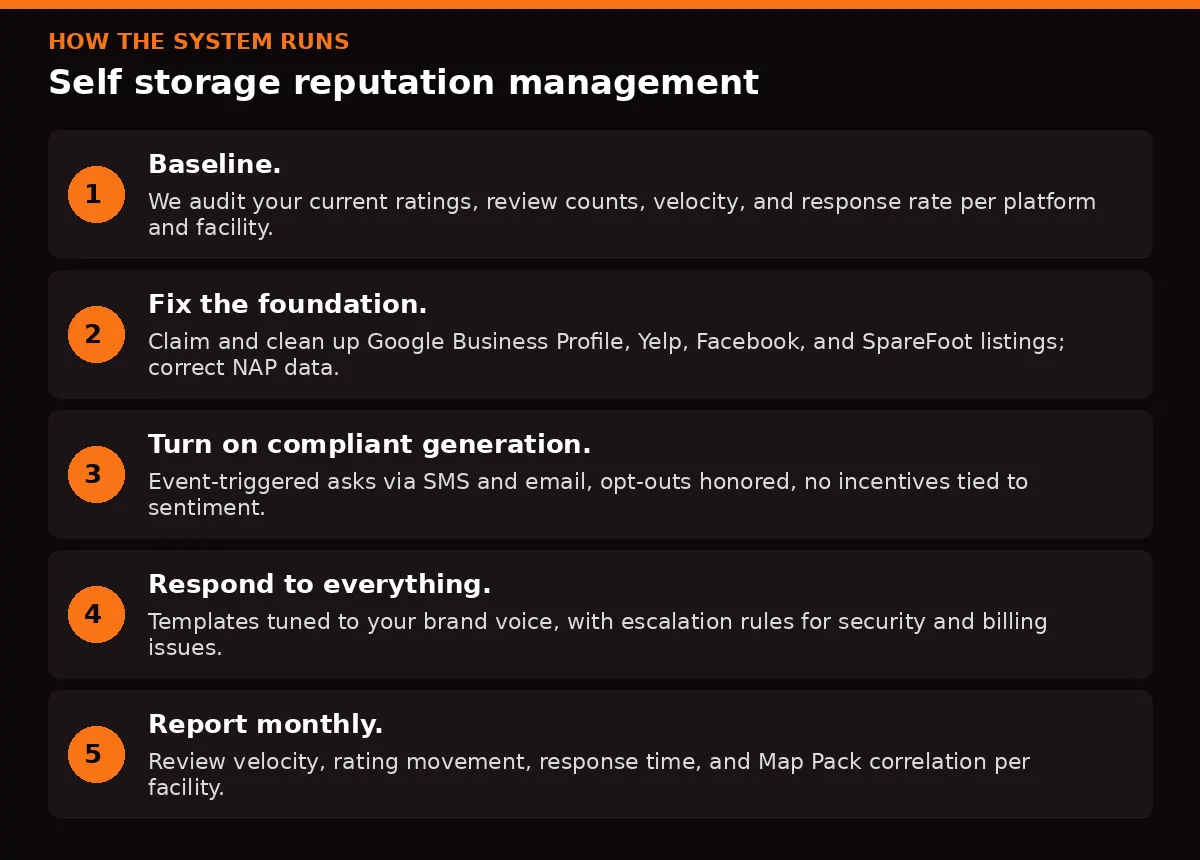
- Baseline. We audit your current ratings, review counts, velocity, and response rate per platform and facility.
- Fix the foundation. Claim and clean up Google Business Profile, Yelp, Facebook, and SpareFoot listings. Correct the name, address, and phone.
- Turn on compliant generation. Event-triggered asks via SMS and email. Opt-outs are honored. No incentive is tied to sentiment.
- Respond to everything. Templates follow the brand voice, with escalation rules for security and billing issues.
- Report monthly. Review velocity, rating movement, response time, and Map Pack correlation per facility.

Three operator scenarios
Scenario 1: a 400-unit facility stuck at 4.1 stars with 60 reviews. Two competitors sit above 4.6 with 200 or more. We turn on move-in SMS asks and response management. If 7 of every 100 move-ins leave a review, and the facility has 80 move-ins a month, that is about five or six new reviews a month. At that pace the gap closes in about a year, with no incentive attached.
Scenario 2: an eight-site portfolio after a rate-increase wave. The increase letters triggered a cluster of angry reviews across three markets. We use a negative-review framework: acknowledge the complaint, do not debate the bill in public, and route it to the regional manager. Nothing is suppressed. Steady new reviews then age the angry ones out of the most recent view.
Scenario 3: a new facility in lease-up with zero reviews. Before opening week ends, every move-in gets the ask sequence. The first 25 reviews arrive while prospects are still comparing the new site with established REITs nearby.
What it costs
Two cost components: software, if you need it, and management. We do not publish a vendor's starter price as your invoice. Management scope depends on facility count, review volume, the response window, and whether we also run generation and fake-review removal. The search-side pricing notes are in self storage SEO cost.
| Cost factor | Lower end | Higher end |
|---|---|---|
| Facilities | 1 to 3 sites | 20 or more sites, priced per location |
| Platforms managed | Google only | Google, Yelp, Facebook, and SpareFoot |
| Response window | 3 business days | 24 hours, including weekends |
| Scope | Responses only | Generation, responses, removal, and reporting |
| Software | You already have it | We select it and run it |
Want the review profile compared with the two competitors beating you? Book a strategy call.
What you get
- A review generation system connected to your facility software, aligned with the FTC rule and Google's review rules
- Response templates and escalation rules in your brand voice
- Cross-platform monitoring with alerts
- Fake review flagging and escalation
- Monthly per-facility reporting: velocity, rating, response time, and Map Pack correlation
- A short staff note on the counter moments that earn five stars, in the same spirit as how to get more Google reviews for storage
Why operators hire SEO for Self Storage
Most review tools sell software and leave you to run it. We are the self storage SEO services team, and we run reputation as a ranking system. Review velocity, the words in the reviews, and whether you reply all feed the Map Pack, so reputation and local SEO are one program. We judge it by move-ins, not by staring at the star average. The same measurement shows up in our case study work. Who does the work is on the about page.
Frequently asked questions
What is self storage reputation management?
It is the ongoing system for generating reviews from real tenants, responding to feedback across Google, Yelp, Facebook, and SpareFoot, monitoring for new reviews, and routing complaints to whoever can fix them. For storage operators, it affects Map Pack rankings and how many searchers choose your facility over the one down the road.
Do Google reviews actually affect my facility's rankings?
Yes. Review count, how recently reviews arrive (velocity), the keywords reviewers use, and whether you respond all feed local ranking systems. A facility with 200 recent, answered reviews will usually outrank an identical facility with 40 stale ones.
Can I offer tenants an incentive to leave a review?
Not for a positive review. The FTC review rule, 16 CFR Part 465, took effect on October 21, 2024, and it bans incentives conditioned on the sentiment of a review. The Federal Register rulemaking cites a maximum civil penalty of $51,744 per violation, and a court can set a lower amount. Google also prohibits incentives. A neutral, identical ask to every tenant is the compliant system.
How many Google reviews does my facility need?
More recent ones than your closest competitors. There is no magic number, but a facility adding five to ten reviews a month will overtake a stagnant competitor within a year. Velocity and recency matter more than the lifetime total. Renters weight the last few months heavily.
How fast should I respond to reviews?
Within 24 hours is the standard we set, especially for negative reviews. The reviewer and every future prospect are watching. Positive reviews need a short, genuine thanks. Negative reviews need acknowledgment, no public debate of account details, and a private resolution path.
Can you remove a fake or unfair review?
We can get reviews removed when they break platform rules: fake accounts, conflicts of interest, the wrong business, or prohibited content. We flag them with evidence and escalate through Google's process. Honest negative reviews stay. The fix is responding well and generating enough honest reviews to put them in proportion.
Should I use review software or a managed service?
Software makes sense if someone on your team will actually run it daily. Otherwise it becomes an expensive notification feed. A managed service makes sense when you would rather outsource the asking, responding, and reporting.
The compliance rules in plain English
Reputation management has a legal floor. The Federal Register final rule on consumer reviews and testimonials took effect on October 21, 2024. It covers fake reviews, buying positive or negative reviews, insider reviews without a clear disclosure, review suppression, and incentives conditioned on sentiment. In that rulemaking the Commission states that the maximum civil penalty is currently $51,744 per violation, and that courts weigh the statutory factors and may impose much less.
- Still legal: asking every tenant for a review, responding to reviews, and reporting reviews that break platform rules. The rule targets deception.
- Google's separate rules: no payment, discount, or free goods in exchange for a review, and no practice of asking only the happy tenants. A practice can break Google's rules, the FTC rule, or both. The Self Storage Association is the trade group for operators comparing how facilities are run while those rules apply.
- The safe pattern: one neutral ask, sent to every eligible tenant at the same moment in the stay, with no incentive tied to the star rating.
Responding to the five review types you will actually get
| Review type | The trap | The response shape |
|---|---|---|
| Security allegation ("my unit was broken into") | Admitting fault in public, or denying specifics | Acknowledge the concern, say security is taken seriously, invite direct contact, and route it internally the same day |
| Billing or rate dispute | Arguing the math in public | Acknowledge it, never discuss account details publicly, and move to a private channel |
| Cleanliness or maintenance | A defensive explanation | Thank them, state the standard, and note the corrective step if one exists |
| Glowing five-star | A generic copy-paste thanks | Short, warm, and specific to something they mentioned |
| Fake or wrong business | An angry reply, which gives it more attention | Report it through the platform process with evidence, and reply calmly once |
SpareFoot is a marketplace many renters still use to shortlist facilities. How that listing interacts with your own site is covered in SEO vs SpareFoot aggregators.
The reporting cadence
Each month, per facility, the report covers new reviews, average rating movement, response time against the agreed window, review velocity versus the two closest competitors, and the themes people praise or complain about. Each quarter we read whether a repeated complaint points at an operations issue, because the cheapest reputation work is fixing the thing people keep naming. You can also write from the contact page.
The platforms beyond Google
Google reviews carry the most weight because they feed the Map Pack. A complete system still watches four places.
| Platform | Why it matters for storage | Priority |
|---|---|---|
| Google reviews | Feeds Map Pack rankings and is the first thing searchers see | Highest. Never optional. |
| SpareFoot | A comparison marketplace where renters shortlist facilities | High if you list there. An ignored profile loses bookings quietly. |
| Yelp | Stronger in some urban and coastal markets, and it feeds Apple Maps | Medium. Claim it and reply. Do not pay for reviews. |
| Community proof. Recommendations move through local groups. | Medium. Keep the page current and answered. |
What review velocity looks like
Use the arithmetic, not a vendor chart. If about 7 of every 100 move-ins leave a review:
- 60 move-ins a month is about 4 reviews.
- 80 move-ins a month is about 6 reviews.
- 100 move-ins a month is about 7 reviews.
Velocity compounds slowly. There is no legitimate shortcut to 200 reviews, so starting now matters more than starting with a blast. A sudden spike looks suspicious to Google and to a competitor's lawyer. Steady asks beat occasional campaigns.
Where this work goes next
Two shifts are already here. First, drafting tools can write a first-pass reply in the brand voice, which cuts response time from days to minutes, as long as a person approves anything that touches billing, security, or a dispute. We use drafting inside an approval step. Second, ChatGPT and AI Overviews weigh review sentiment and recency when they recommend a facility, so the review profile now affects answers that did not exist as a channel two years ago. Steady, compliant generation is the asset that carries into those answers.
The short version
Generate reviews from every eligible tenant, answer them within a day, never pay for a star or filter who gets asked, and send every complaint to someone who fixes the underlying problem. Do those four things for twelve months and the profile becomes a reason renters choose you before they call.
Your next renter is reading your reviews right now
Self storage reputation management turns reviews from a liability you watch into an asset that ranks. Steady generation, professional responses, and nothing that violates the FTC rule or Google's review rules.
Book a strategy call and we will show you where the review profile stands against the facilities beating you, and the 90-day plan to pass them.