
AI for self storage is software that handles the work between a renter's first call and a signed lease: answering phones and chats around the clock, quoting live prices from your facility management software, booking units, following up with leads, and sending tenant messages. For most operators it pays for itself by capturing the calls that used to hit voicemail.
Key takeaways
- The phone is still where most storage rentals are won or lost; AI call answering is the highest-ROI first AI tool for most facilities.
- Real AI for storage works inside your FMS (storEDGE, SiteLink, Self Storage Manager) so it quotes live availability and street rates — anything else is voicemail with extra steps.
- A useful system quotes live availability from your facility software. A script that cannot see inventory is just a longer voicemail.
- Start with one tool, measure cost per move-in for 90 days, then expand. Don't buy the whole stack on day one.
- Risks are manageable — misquoted rates, gate-code security, TCPA rules — but only if you configure guardrails before go-live.
Updated November 2026. This operations work sits beside self storage SEO agency campaigns that bring the renter to the phone in the first place.
In this guide: What AI for self storage actually means · Who this service is for · The AI toolkit, category by category · What it costs · How we implement it · Deliverables · Why operators hire us · FAQ
What "AI for self storage" actually means
AI for self storage means software that does front-desk and back-office work a person used to do: answering calls, qualifying leads, quoting prices, booking units, sending reminders, and flagging problems. The useful kind connects to your facility management software so it acts on live data. The useless kind reads a script.
That distinction matters more than any brand name. A chatbot that can only answer "what are your hours" is a FAQ page with a personality. An AI agent connected to storEDGE can tell a caller at 11 p.m. that a 10x10 is available, quote the current street rate, apply your move-in special, and book the unit. One of those fills units. Google's own guidance on creating helpful, people-first content is the same test: the page and the phone should answer the question the renter actually asked.
Who this service is for
We build AI systems for three kinds of operators:
- Independent owners with one to five facilities who lose after-hours calls to whoever picks up first. You don't need a call center; you need the phone answered.
- Multi-facility operators and regional chains who want consistent answers across locations without hiring and training more front-desk staff.
- Developers and lease-up facilities that can't afford to miss a single inquiry while occupancy is climbing.
If you're evaluating AI marketing for self storage separately — content, ads, and AI-search visibility — that's the sister service to this operations page. It is not live yet, so start with marketing for storage facilities. This page covers the operations side: calls, bookings, pricing, and tenant communication. The Self Storage Association is the trade group for operators comparing how facilities are run.
The AI for self storage toolkit, category by category
1. AI call answering — the highest-ROI first buy
Voice AI answers your facility line in one or two rings, identifies the caller, pulls live availability and rates from your FMS, quotes the current street rate, and either books the unit or captures the lead for follow-up. Good systems text a one-tap payment link to past-due tenants and hot-transfer genuinely complex calls to your staff.
Category leaders publish their own volume and resolution figures. Treat those as the vendor's claims, not as your forecast. Judge a pilot on your missed calls and the units that get booked. The phone number on your Google Business Profile should be the same line the software answers. Our notes on counting those calls are in call tracking and attribution for storage. For how an answered call becomes a lease, see how SEO fills storage units.
2. Website chatbots that book, not just answer
A booking-capable chatbot asks qualifying questions — move-in date, how much they need to store, drive-up or indoor — then either reserves the unit or hands a pre-qualified lead to your team. An FAQ bot answers hours and directions and lets the actual sales conversation sit unattended overnight. Know which one you're buying. The closest live walkthrough of that booking path is the online reservation flow for a storage website.
3. AI pricing and revenue management
AI revenue management adjusts street rates against occupancy, seasonality, and competitor pricing — raising rates on a 10x10 that's 95% full and triggering a promo on the 10x20s that won't move. This is where AI directly grows revenue per unit rather than just cutting workload. See live availability and pricing on storage pages and self storage SEO cost and pricing.
4. AI lead follow-up
Most storage leads compare two or three facilities. The one that responds first usually wins. AI follow-up sends an SMS and email within seconds of an inquiry and keeps nurturing until the prospect books or says stop. The live companion is marketing for storage facilities, which covers how those inquiries get created.
5. Tenant communication and collections
Automated payment reminders, move-in instructions, gate-code reissues, and past-due sequences — the repetitive messages that eat a manager's day. Tenant messages overlap with reputation management for a storage facility. Payment disputes that the software should not touch are covered with the other failure modes in self storage SEO mistakes.
6. AI across your existing software
If you run Storable products — storEDGE, SiteLink, or Storable websites — tool choice narrows to what actually integrates. The site-side version of that question is in technical SEO for a storage website.
| Category | What it does | Buys you | First buy? |
|---|---|---|---|
| AI call answering | Answers, quotes, books by phone 24/7 | Missed-call revenue | Yes — most operators |
| Booking chatbot | Qualifies and books on your website | Higher web conversion | If web leads > phone leads |
| AI pricing | Adjusts street rates by demand | Revenue per unit | After occupancy stabilizes |
| Lead follow-up | Instant SMS/email nurture | Speed-to-lead wins | Yes, pairs with answering |
| Tenant messaging | Reminders, codes, collections | Manager hours back | After call answering |
| AI marketing | Content, ads, AI-search visibility | More inbound demand | Start with marketing for storage facilities |
What this looks like in practice (three operator scenarios)
Scenario 1: a 450-unit facility at 82% occupancy in a REIT-heavy suburb. The site loses weekend calls to a CubeSmart two miles away. AI call answering goes live on the main line; after-hours calls now get quoted and booked immediately. Within one quarter, weekend voicemail drops to zero and the Saturday-morning "call back list" disappears.
Scenario 2: a three-site regional operator with one floating manager. Leads arrive by phone, web chat, and text across three locations and get lost between them. A unified AI layer answers all three lines with location-specific pricing, and every conversation lands in one inbox with transcripts.
Scenario 3: a 25-location portfolio standardizing on storEDGE. The operator wants one vendor, one playbook, and portfolio-level reporting. We roll out answering plus follow-up in five-facility waves, with a dashboard comparing cost per move-in by site before expanding.
What AI for self storage costs
We don't publish a fixed package price because the right number depends on your setup. Vendors advertise starter prices that change with call volume, facility count, and whether the tool can book into your software. Do not treat a vendor's advertised starter price as your cost. Compare the invoice with the move-ins you can attribute. How we talk about scope and pricing for search work is in self storage SEO cost and pricing.
| Factor | Pushes cost down | Pushes cost up |
|---|---|---|
| Call volume | A quiet single line | Heavy volume across sites |
| Facilities | Single site | Multi-site, per-location pricing |
| Integration | Native storEDGE/SiteLink connector | Custom or legacy FMS work |
| Scope | Answering and message taking | Booking, payments, collections |
| Setup | You configure, we review | We configure and train |
Want this scoped for your facilities? Book a strategy call and we'll map your call volume, software, and the one AI tool worth buying first.
How we implement AI at your facility
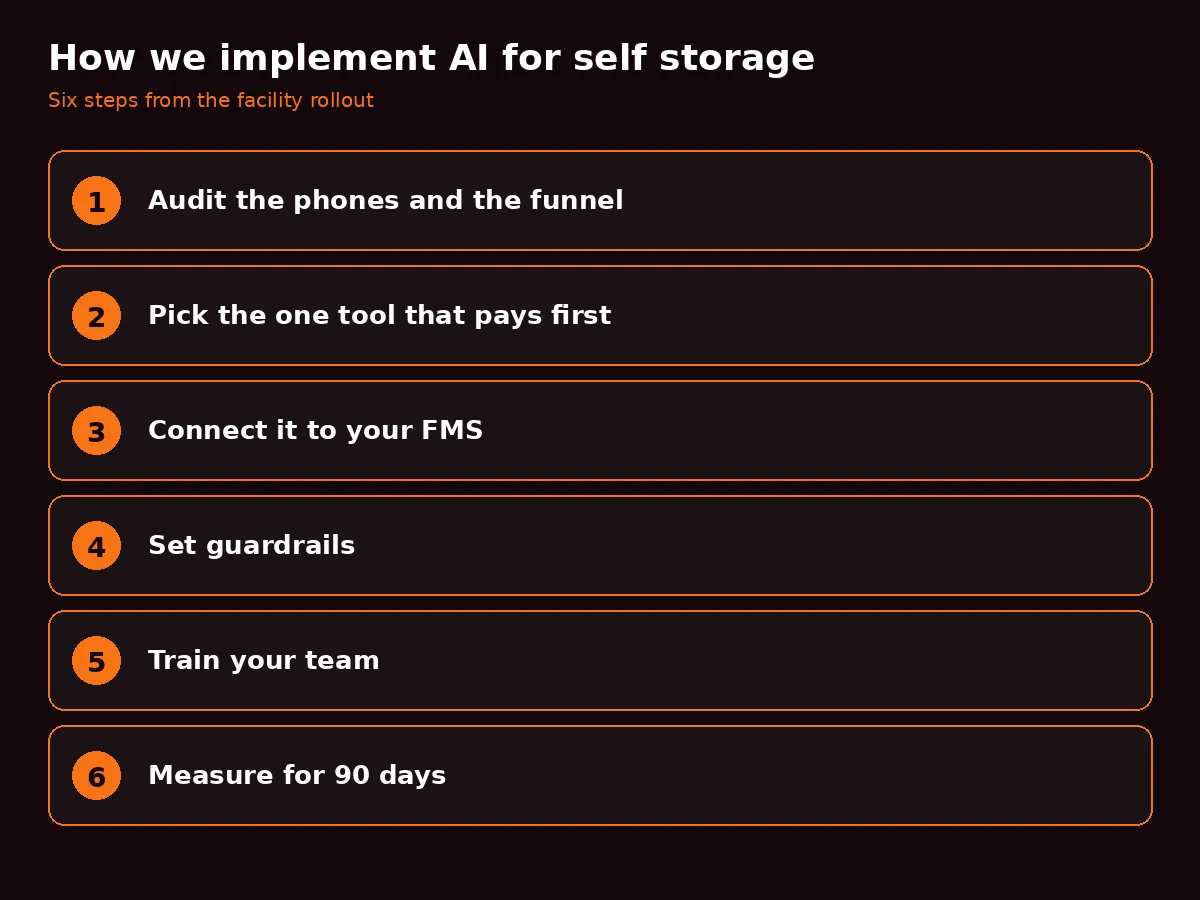
- Audit the phones and the funnel. We pull call logs, missed-call counts, and lead sources so the case is built on your numbers, not vendor promises.
- Pick the one tool that pays first. Usually call answering; sometimes the chatbot if your web leads outnumber calls.
- Connect it to your FMS. storEDGE, SiteLink, or Self Storage Manager — live rates and availability or nothing.
- Set guardrails. Rate floors and ceilings, gate-code rules, escalation paths, and TCPA-compliant language for every automated call and text. The practical failure modes are grouped with self storage SEO mistakes.
- Train your team. What the AI handles, what it hands off, and how to read transcripts.
- Measure for 90 days. Answered calls, bookings attributed, cost per move-in — then expand or adjust. The site-structure side of that discipline is in site architecture for a storage website.
What you get (deliverables)
- A recommended stack with a vendor shortlist and a total cost you can compare with move-ins
- Configured AI answering (or your chosen first tool), connected to your FMS
- Call flows, rate rules, and escalation paths documented for your team
- A compliance checklist covering TCPA, disclosure, and gate-code security
- A 90-day measurement dashboard tied to move-ins, not vanity metrics
- Quarterly reviews as the tools and the search results shift, using the same habits as our self storage SEO best practices
Why operators hire SEO for Self Storage for AI work
We're operators' marketers, not software resellers. We don't take commissions from AI vendors, so the recommendation is whatever fits your facilities. And because AI visibility increasingly decides which facility gets recommended in the first place, we connect the operations work to the demand side — the same company that runs your self storage SEO services engagement can make sure the rentals your AI books actually compound into rankings and reviews. That's the same operator-first approach we apply across our self storage SEO guide. A facility example of the search side is in the self storage SEO case study. Who does the work is on the about page.
The risks, and the guardrails that handle them
AI at a storage facility fails in predictable ways. Here's each failure mode and the guardrail that prevents it:
| Risk | What it looks like | Guardrail |
|---|---|---|
| Misquoted rates | AI quotes a stale or wrong street rate | Hard rate floors and ceilings; FMS-synced pricing only; never let the software guess |
| Gate-code exposure | AI hands an access code to the wrong person | Two-step identity verification; codes only after payment clears; full logs |
| Awkward escalations | AI loops instead of transferring | Confidence thresholds that transfer to a human with the full transcript |
| TCPA violations | Automated texts or calls without consent language | Compliant scripts, quiet hours, and opt-out handling reviewed before go-live |
| Lien and dispute errors | AI negotiates a payment issue it shouldn't touch | Billing disputes and lien topics route to humans by rule, always |
The pattern: every risk is a configuration problem, not a reason to avoid the category. The operators who get burned are the ones who switched a tool on with default settings.
What AI does to your staffing math

AI doesn't eliminate front-desk cost — it changes what that cost buys. A manager who spent four hours a day on routine calls gets those hours back for property walks, tenant relationships, and the local outreach that actually differentiates an independent facility. Remote models go further: with answering software, smart access, and monitoring combined, some operators run facilities with no daily on-site presence at all. The live page for staying visible when staff are not at a desk is local SEO for a self storage facility. The point isn't fewer people; it's that your people stop being an answering service and start being an operations team.
Ten questions to ask any AI vendor before signing
- Show me a live call against my actual FMS inventory — not a demo dataset.
- What happens when the AI doesn't know an answer? Play me that recording.
- Which rate sources does it quote from, and how fresh are they?
- How does identity verification work before any account detail or gate code is discussed?
- What are your overage charges after the included volume?
- Which FMS platforms have native integrations, and what breaks without one?
- How do I see transcripts, and can I set rules from them?
- What's the escalation path and average transfer time to a human?
- What compliance controls exist for TCPA and AI disclosure?
- What's the contract term, and what does cancellation actually involve?
If a vendor can't answer these plainly, that's your answer.
AI answering vs a traditional answering service
Operators often weigh AI against the old option — a human answering service. The difference is capability, not a sticker price. A traditional service takes a message; it can't see your inventory, quote a rate, or book a unit, so the caller still waits for a callback — and renters calling three facilities don't wait. An AI agent connected to your FMS resolves the call in one touch. Human answering services still win for genuinely unusual situations, which is why the right setup routes those calls to your team rather than pretending the software handles everything.
One more scenario — the skeptical two-site owner. An operator with two facilities insists tenants "want to talk to a person." We put AI answering on the smaller site only and ran it for 90 days against the unchanged larger site. The AI site answered every call within two rings, around the clock; the control site kept banking hours and voicemail. The operator's takeaway wasn't that tenants love AI — it's that tenants love answers, and they couldn't tell the difference at 9 p.m. on a Sunday. That's the test worth running at your own facilities before any portfolio-wide decision.
Where AI in storage goes next
The near-term direction is integration, not novelty. The tools that win the next two years will be the ones that share one customer record across calls, chat, text, and email — so a renter who starts in web chat at lunch and calls after dinner doesn't start over. Watch for tighter FMS connections, better voice quality, and software that handles more than one language as standard. The operators who benefit most won't be the earliest adopters of every new tool; they'll be the ones with one well-configured system, measured honestly, that they expand only when the numbers justify it.
Ready to stop losing rentals to voicemail?
AI for self storage works when it's connected to your real inventory, configured with guardrails, and measured against move-ins. That's exactly how we deploy it — whether you run one facility or fifty.
Book a strategy call with SEO for Self Storage and we'll tell you which AI tool pays for itself first at your facilities — and which ones to skip.
Frequently asked questions
Will callers know they're talking to AI?
Usually yes within seconds, and most don't care — renters overwhelmingly prefer an instant, accurate answer over voicemail. Good systems disclose honestly when asked, quote only configured rates, and transfer to a human when the conversation gets unusual. Tenant satisfaction holds up well when the AI is upfront and competent.
Can an AI actually book a unit, or does it just take messages?
It can book — if it's connected to your facility management software. An AI working inside storEDGE or SiteLink can create the reservation, apply your move-in special, and send confirmation during the call. A system without that connection can only take a message, which is voicemail with extra steps.
Does AI call answering work with my management software?
The major tools integrate natively with storEDGE, SiteLink, and Self Storage Manager, and some vendors operate any browser-based system. Before buying, ask for a live demonstration against your actual FMS — quoting live rates from your real inventory, not a demo dataset.
How much does AI for self storage cost?
Vendors price AI answering by call volume or by facility. Chatbots, pricing tools, and marketing AI are separate line items. Scope your call volume and facility count first, then compare the total with the move-ins you can attribute.
Will AI replace my front-desk staff?
No — it covers the hours and volume your team can't: nights, weekends, and simultaneous calls. Disputes, lien conversations, lockouts with complications, and anything sensitive still route to people. Most operators redeploy manager time to property condition and tenant relationships instead of the phone.
Is AI call and text outreach legal for collections and reminders?
Yes, with rules. The TCPA governs automated calls and texts, AI disclosure requirements are tightening, and payment conversations need secure flows. Configure consent language, quiet hours, and escalation paths before go-live — we build this checklist into every deployment.