self storage seo mistakes

Top 7 Self Storage SEO Mistakes: How to Fix What’s Keeping Your Units Empty Quick Navigation Get Found on the Map: Fix Your Neglected Google Business Profile Stop Competing With Yourself: Repair Duplicate & Thin Location Pages Target Renters, Not Robots: Fix Your Keyword Strategy Build Trust That Ranks: Stop Ignoring Online Reviews Win the Mobile Race: Fix Your Slow, Clunky Website Clean Up Your Digital Footprint: Fix NAP & Citation Inconsistencies Measure What Matters: Stop Flying Blind Without Tracking You’re doing “SEO.” Or at least, someone told you that you are. You have a website. You might even have a blog post or two floating around from 2019. And yet, when someone three miles away searches “storage units near me,” your facility is nowhere to be found — while the Public Storage down the street sits pretty at the top of the map pack. A specialist self storage SEO company can diagnose and fix every one of these mistakes faster than going it alone. Here’s the uncomfortable truth: most self storage SEO mistakes aren’t about what you’re not doing. They’re about what you’re doing wrong. And in this industry, wrong is expensive. Industry data suggests that the vast majority of storage renters start their search online, and roughly 75% of clicks go to businesses showing up in the top local results. If a fixable mistake is keeping you out of those spots, every day that passes is a rental that went to a competitor. Another question operators often get wrong: how much should SEO actually cost, and what should you get for the money? The self storage SEO cost guide breaks down realistic pricing ranges so you can tell a worthwhile investment from a money pit. Think of your SEO like your facility’s gate code system. It doesn’t matter how nice your units are, how competitive your rates are, or how friendly your manager is — if the gate code doesn’t work, nobody gets in. SEO mistakes are broken gate codes on the internet. The good news? Every single one on this list is fixable, most of them faster than you’d think. Let’s walk through the seven most common self storage SEO mistakes we see facility owners make — and exactly how to fix each one. 1. Neglecting Your Google Business Profile (or Setting It and Forgetting It) Why? Your Google Business Profile is the single biggest driver of local storage rentals — and a neglected one actively suppresses your rankings. Here’s a scenario that plays out constantly: an owner claims their Google Business Profile years ago, fills in the bare minimum, and never touches it again. Wrong hours listed. No photos. No posts. Review questions unanswered. Then they wonder why the map pack ignores them. Research shows that businesses with complete, actively maintained Google Business Profiles get significantly more clicks, calls, and direction requests than incomplete listings. For a full breakdown of every GBP setting, posts cadence, and Q&A seeding, see the GBP posts, Q&A, and photo strategy guide — some industry analyses put the difference at 70% or more. For storage facilities, where the decision is almost entirely local and convenience-driven, the map pack is the battlefield. Google’s local algorithm weighs profile completeness, activity, and engagement heavily. A stale profile tells Google — and potential renters — that your facility might be stale too. Here’s how to implement this: Audit your profile today. Search your facility name on Google and check every field: hours (including holiday hours), phone number, website URL, and attributes like “climate controlled” or “24-hour access.” Add 20+ real photos. Exterior signage, office, units (empty and staged), security features, and your moving carts. Profiles with photos get far more engagement than those without. Choose the right categories. Primary category: “Self-storage facility.” Add secondary categories like “Moving supply store” or “RV storage facility” if they apply. Post weekly. A unit availability update, a seasonal tip, a move-in special. It takes five minutes and signals an active business. Answer the Q&A section yourself. Seed common questions (“Do you offer month-to-month leases?”) and answer them before random strangers do it for you. Self Storage Pro Tip: Your business description is prime real estate. Naturally include your city name and top services — “climate-controlled storage units in [City] with drive-up access and 24/7 gate entry” — instead of a generic “We provide storage solutions.” Google indexes this text, and renters scan it before they ever visit your site. Read more: Google Business Profile optimization for self storage — the complete eight-step setup guide. And before you touch anything else, make sure your core on-page signals are right. The on-page SEO checklist for storage facility websites covers every element — title tags, headers, URLs, internal links — that Google uses to decide which facility to rank. Takeaway: An unclaimed or neglected Google Business Profile is like having a facility with no signage — fix it this week, because it’s the highest-leverage SEO move you can make. 2. Publishing Duplicate or Thin Location Pages Why? If your pages are copy-paste clones with the city name swapped out, Google may rank none of them. This is one of the most common self storage SEO mistakes for multi-location operators — and even single facilities with multiple “service area” pages. The pattern looks like this: a template page where the only difference between “Storage Units in Springfield” and “Storage Units in Shelbyville” is the city name in the headline. Google sees this as duplicate content, and instead of picking one page to rank, it often just… doesn’t rank any of them well. If you operate more than one facility, the multi-location self storage SEO guide covers the right architecture to avoid this at scale. Industry data suggests that pages with substantial unique, locally relevant content consistently outrank templated pages in local search. Google’s helpful content systems are specifically designed to demote pages that exist only to catch searches rather than serve people. Each location page is a salesperson for that facility —
seo vs sparefoot aggregators
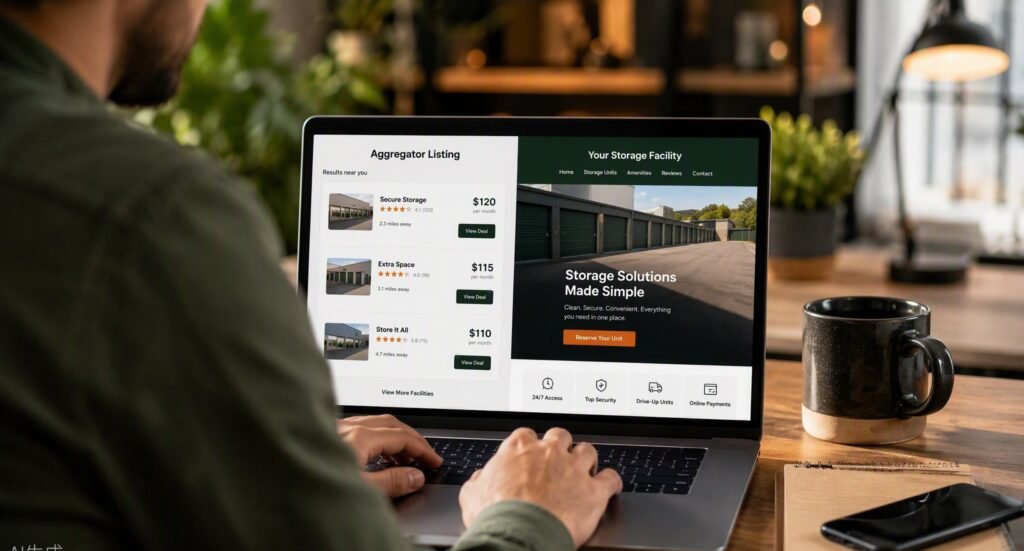
Top 8 Self Storage SEO vs SpareFoot Strategies: Own Your Demand and Keep More of Every Rental Quick Navigation Audit the real cost: Calculate what SpareFoot actually charges you per rental Protect your name: Take back your branded search results Win the map: Dominate the Google Map Pack for “near me” searches Outrank the aggregators: Build location pages that beat aggregator listings Convert direct traffic: Turn your website into a direct-rental machine Use SpareFoot on your terms: Use aggregators strategically — as a channel, not a crutch Harvest their renters: Convert aggregator renters into direct customers Measure demand ownership: Track the metrics that prove SEO is winning Why the Self Storage SEO vs SpareFoot Debate Matters More Than You Think Here’s a scenario every independent operator knows too well. A customer two miles from your facility needs a 10×10. They Google “storage units near me,” click the first result — SpareFoot — browse listings that include your property, and reserve a unit. You get the move-in. You also get a bill for roughly one month’s rent, sometimes more, for a customer who was probably going to find you anyway. Now think of it this way: SpareFoot is the food delivery app of the storage industry. Restaurants love DoorDash for filling seats on slow Tuesdays, but nobody wants to hand over 30% of every order forever — especially orders from regulars around the corner. Aggregators are a channel. The mistake is letting them become your only channel: the moment you stop paying, your “occupancy” stops too. You never owned that demand. You were renting it. That’s the real self storage SEO vs SpareFoot question. It’s not “which one works” — both can put renters in units. It’s “who owns the customer relationship, and what does each move-in cost you over the next five years?” This guide breaks down eight strategies to shift your demand from rented to owned, so aggregators become an optional supplement instead of a permanent tax on revenue. New to the search side of this? Start with [Link to: Self Storage SEO: The Complete Guide for Facility Owners] and come back — this article assumes you’re ready to run the numbers. Or talk directly to our self storage SEO specialists about building a direct-demand channel for your facility. 1. Calculate What Aggregators Are Really Costing You Why? You can’t win a fight you haven’t measured — most operators dramatically underestimate their true aggregator cost per rental. The core problem is accounting fog. SpareFoot and similar marketplaces typically charge a referral fee per move-in — often around one month’s rent or a flat commission — plus listing or promoted-placement fees. Because the invoice arrives after the rental and revenue arrives gradually, the expense feels small. It isn’t. Industry data suggests that for facilities listed on major aggregators, those channels can account for 10% to 30% of total move-ins. Run the math on a facility doing 40 move-ins a month: if a quarter come through an aggregator at an average $110 unit rate, that’s roughly $1,100 a month — over $13,000 a year — for demand you may be generating yourself through reputation and drive-by traffic anyway. The psychology here is simple: aggregators sell certainty. A guaranteed rental today feels better than an uncertain ranking tomorrow. But certainty at 15–25% of revenue is the most expensive marketing you’ll ever buy. Here’s how to implement this: Pull 12 months of aggregator invoices and total every fee: referral commissions, listing fees, promoted-placement charges. Divide total fees by aggregator-attributed move-ins to get your true cost per rental (CPR). Don’t use their dashboard’s rosy attribution — cross-reference against your management software. Calculate CPR as a percentage of lifetime value. A $130 fee on a tenant worth $1,200 (10 months × $120) is ~11% — and if that tenant would have found you on Google anyway, the effective cost is far higher. Build a benchmark sheet: aggregator CPR vs. paid ads CPR vs. organic cost per rental (SEO spend divided by organic move-ins). Set a dependency threshold. Decide the maximum share of move-ins you’ll accept from aggregators — many healthy operators target under 10–15%. Self Storage Pro Tip: Ask your aggregator rep for a “first-touch vs. last-touch” breakdown. Aggregators count any rental they touched — even customers who saw your yard sign, drove home, and booked through the listing because it ranked above your site for your own name. That’s not new demand. That’s intercepted demand, and you shouldn’t be paying acquisition prices for it. If you’d rather hand off the SEO side entirely and let a specialist build your direct-demand channel, see what our self storage SEO company does for independent operators. Read more: [Link to: What Is Self Storage SEO and Why Does It Matter for Occupancy?] Takeaway: Until you know your real cost per aggregator rental and your dependency percentage, every other decision in this article is a guess. 2. Take Back Your Branded Search Results Why? If an aggregator ranks #1 for your own facility’s name, you’re paying commissions on customers who were already yours. Google your facility name right now. Seriously — open an incognito window and search “[Your Facility Name] + [City].” If SpareFoot, SelfStorage.com, or another marketplace appears above your website, you have a branded-search leak. Research shows the top organic result captures roughly 25–30% of clicks, and branded searches convert at two to three times the rate of generic ones. These are your hottest prospects — and someone else is shaking their hand first. This happens because aggregators have massive domain authority. Google often treats their listing page as the “best answer” for your brand unless your own site sends stronger signals. Here’s how to implement this: Optimize your homepage title tag and H1 for your exact brand name + city — e.g., “Maple Grove Self Storage | Climate-Controlled Units in Maple Grove, MN.” Claim and fully complete your Google Business Profile with your exact brand name, correct categories, photos, and direct booking URL. Build citations
self storage seo cost
Top 7 Self Storage SEO Timeline Factors: When Will Your Units Start Filling Up? Quick Navigation — Jump to the Section You Need: Set honest expectations: Why self storage SEO has its own timeline Know the phases: The month-by-month SEO timeline breakdown Read your market: How competition level changes everything Audit your starting point: Why your website’s age and condition matter Get early wins: The Google Business Profile fast track Speed it up: Content and keyword strategies that compress the timeline Build momentum: Reviews and citations that compound over time Other self storage SEO timeline questions (rapid-fire answers) Frequently asked questions How to get started today You’ve probably heard the classic SEO answer: “It takes 4 to 12 months.” Thanks. Super helpful. That’s like asking a contractor how long a renovation takes and hearing “somewhere between a weekend and a year.” Here’s the problem: how long self storage SEO takes depends on factors generic advice never accounts for. A 150-unit facility in a rural market with one competitor is playing a completely different game than a new build in a metro area going up against Public Storage, CubeSmart, and Extra Space — all with marketing teams and domain authority built over a decade. Think of SEO like filling a facility from zero occupancy. Open in an underserved market and you might hit 60% occupancy in six months. Open the same facility in a saturated corridor, and you’re fighting for every rental for two years. SEO works the same way — the timeline isn’t about the tactic, it’s about the terrain. This guide gives you the real timelines: by market competition, by facility and website age, and by starting condition — plus exactly what to do at each stage so you’re not just waiting for Google to notice you. Let’s get into it. And if you want an expert running the strategy while you run the facility, our self storage SEO service handles every phase described below. 1. Understand Why Self Storage SEO Has Its Own Timeline Why? Because self storage is one of the most local, most intent-driven searches on the internet — and that changes both the competition and the speed of results. When someone types “storage units near me” into Google, they’re not browsing. Industry data suggests that roughly 46% of all Google searches have local intent, and research shows 28% of local searches result in a purchase within 24 hours. That urgency works in your favor: Google treats storage queries as “local pack” searches — the map results at the top — and local pack rankings move faster than traditional organic rankings. A plumber trying to rank nationally might wait a year. You, targeting “climate controlled storage in [your town],” can see movement in weeks. But here’s the catch that trips up most owners: storage SEO timelines are front-loaded with setup work and back-loaded with compounding results. Months one and two feel like nothing is happening. Months four through eight feel like everything is happening at once. That’s not a bug — it’s how local search trust is built. Here’s how to implement this: Set your baseline now. Before changing anything, record your rankings for your top 5 money keywords, website traffic, and how many monthly rentals come from organic search versus paid. Define what “working” means. For most facilities, success isn’t ranking #1 for a vanity term — it’s 3 to 10 additional move-ins per month from unpaid search. Pick your number. Budget for the timeline, not just the cost. Need rentals in 30 days? Run paid ads while SEO builds. Planning a lease-up 12 months out? SEO is your highest-ROI channel. Self Storage Pro Tip: Track “rental source” on every move-in — a simple dropdown in your management software. Operators who do this discover that organic leads convert at noticeably higher rates than paid leads, because organic searchers have already done their comparison shopping. Without this data, you can’t tell whether your timeline is on track or you’re just waiting for nothing. Read more: [Link to: What Is Self Storage SEO and Why Does It Matter for Occupancy?] Want to skip the learning curve? Our self storage SEO specialists know exactly what to do in every phase — and they’ve done it for facilities just like yours. Takeaway: Self storage SEO runs on local search rules, not generic SEO rules — expect setup time up front and compounding returns later, and measure success in move-ins, not rankings. 2. Know the Real Month-by-Month SEO Timeline Why? Because owners who don’t know the phases quit in month three — right before the results start. Ask any honest SEO professional how long self storage SEO takes and, done right, the answer follows a predictable arc: Months 1–2: The Foundation Phase (Nothing Visible Happens) This is the audit-and-fix phase: technical cleanup, GBP optimization, citation building, keyword mapping, on-page fixes. Google is re-crawling and re-indexing your site, and rankings may bounce around — that’s normal. This is where most owners panic and pull the plug. Don’t. Months 3–4: The First Movement Phase You start appearing on page one for long-tail, low-competition terms (“RV storage [small suburb],” “10×20 units [city]”), and the local pack shows you for searches near your address. Research shows about 75% of searchers never scroll past page one — so these early wins, even on smaller terms, start producing real calls. Months 5–6: The Traction Phase Your money keywords (“storage units [city]”) move from page two or three into the bottom half of page one. Review velocity builds; content pages rank. This is when owners first report, “Hey, we got two rentals last week from people who found us on Google.” Months 7–12: The Compounding Phase This is where SEO becomes your cheapest channel. Industry data suggests the top three local pack results capture roughly 44% of all clicks on a local search page. Crack that top three for your core terms, and lead flow becomes consistent — and unlike ads, it doesn’t stop when you
how long does storage seo take

Top 7 Self Storage SEO Timeline Factors: When Will Your Units Start Filling Up? Quick Navigation — Jump to the Section You Need: Set honest expectations: Why self storage SEO has its own timeline Know the phases: The month-by-month SEO timeline breakdown Read your market: How competition level changes everything Audit your starting point: Why your website’s age and condition matter Get early wins: The Google Business Profile fast track Speed it up: Content and keyword strategies that compress the timeline Build momentum: Reviews and citations that compound over time Other self storage SEO timeline questions (rapid-fire answers) Frequently asked questions How to get started today You’ve probably heard the classic SEO answer: “It takes 4 to 12 months.” Thanks. Super helpful. That’s like asking a contractor how long a renovation takes and hearing “somewhere between a weekend and a year.” Here’s the problem: how long self storage SEO takes depends on factors generic advice never accounts for. A 150-unit facility in a rural market with one competitor is playing a completely different game than a new build in a metro area going up against Public Storage, CubeSmart, and Extra Space — all with marketing teams and domain authority built over a decade. Think of SEO like filling a facility from zero occupancy. Open in an underserved market and you might hit 60% occupancy in six months. Open the same facility in a saturated corridor, and you’re fighting for every rental for two years. SEO works the same way — the timeline isn’t about the tactic, it’s about the terrain. This guide gives you the real timelines: by market competition, by facility and website age, and by starting condition — plus exactly what to do at each stage so you’re not just waiting for Google to notice you. Let’s get into it. If you’d rather skip the DIY phase and hand this off to a specialist, our self storage SEO company manages every stage of the timeline for you. 1. Understand Why Self Storage SEO Has Its Own Timeline Why? Because self storage is one of the most local, most intent-driven searches on the internet — and that changes both the competition and the speed of results. When someone types “storage units near me” into Google, they’re not browsing. Industry data suggests that roughly 46% of all Google searches have local intent, and research shows 28% of local searches result in a purchase within 24 hours. That urgency works in your favor: Google treats storage queries as “local pack” searches — the map results at the top — and local pack rankings move faster than traditional organic rankings. A plumber trying to rank nationally might wait a year. You, targeting “climate controlled storage in [your town],” can see movement in weeks. But here’s the catch that trips up most owners: storage SEO timelines are front-loaded with setup work and back-loaded with compounding results. Months one and two feel like nothing is happening. Months four through eight feel like everything is happening at once. That’s not a bug — it’s how local search trust is built. Here’s how to implement this: Set your baseline now. Before changing anything, record your rankings for your top 5 money keywords, website traffic, and how many monthly rentals come from organic search versus paid. Define what “working” means. For most facilities, success isn’t ranking #1 for a vanity term — it’s 3 to 10 additional move-ins per month from unpaid search. Pick your number. Budget for the timeline, not just the cost. Need rentals in 30 days? Run paid ads while SEO builds. Planning a lease-up 12 months out? SEO is your highest-ROI channel. Self Storage Pro Tip: Track “rental source” on every move-in — a simple dropdown in your management software. Operators who do this discover that organic leads convert at noticeably higher rates than paid leads, because organic searchers have already done their comparison shopping. Without this data, you can’t tell whether your timeline is on track or you’re just waiting for nothing. Read more: [Link to: What Is Self Storage SEO and Why Does It Matter for Occupancy?] Takeaway: Self storage SEO runs on local search rules, not generic SEO rules — expect setup time up front and compounding returns later, and measure success in move-ins, not rankings. 2. Know the Real Month-by-Month SEO Timeline Why? Because owners who don’t know the phases quit in month three — right before the results start. Ask any honest SEO professional how long self storage SEO takes and, done right, the answer follows a predictable arc: Months 1–2: The Foundation Phase (Nothing Visible Happens) This is the audit-and-fix phase: technical cleanup, GBP optimization, citation building, keyword mapping, on-page fixes. Google is re-crawling and re-indexing your site, and rankings may bounce around — that’s normal. This is where most owners panic and pull the plug. Don’t. Months 3–4: The First Movement Phase You start appearing on page one for long-tail, low-competition terms (“RV storage [small suburb],” “10×20 units [city]”), and the local pack shows you for searches near your address. Research shows about 75% of searchers never scroll past page one — so these early wins, even on smaller terms, start producing real calls. Months 5–6: The Traction Phase Your money keywords (“storage units [city]”) move from page two or three into the bottom half of page one. Review velocity builds; content pages rank. This is when owners first report, “Hey, we got two rentals last week from people who found us on Google.” Months 7–12: The Compounding Phase This is where SEO becomes your cheapest channel. Industry data suggests the top three local pack results capture roughly 44% of all clicks on a local search page. Crack that top three for your core terms, and lead flow becomes consistent — and unlike ads, it doesn’t stop when you stop paying. Year 2+: The Moat Phase Your domain authority, review count, and content library become assets competitors can’t quickly copy. This is how independents hold
local seo rural storage

Top 7 Local SEO for Rural Storage Facilities Ideas: Own Every Search in Your Small Market Quick Navigation Claim your map territory: Optimize Google Business Profile for a wide rural service area Win the “near me” battle: Rank in the Map Pack even with a small population base Build reviews in a small town: Turn a small customer pool into a big reputation Create hyperlocal content: Become the storage authority for every nearby town Fix your citations: Make NAP consistency work in markets with messy rural addresses Get rural backlinks: Leverage local relationships big-city competitors don’t have Track what matters: Measure leads and rentals, not vanity traffic Why Generic Local SEO Advice Fails Rural Storage Owners Most local SEO advice is written for businesses fighting over 500,000-person metro areas. “Target these 40 keywords! Build 200 citations! Post daily!” That playbook assumes you’re competing against dozens of facilities within a five-mile radius. Our self storage SEO services are built specifically for storage operators — rural, suburban, and urban alike. But you? You might be the only climate-controlled facility within 30 miles. Or one of three facilities serving a county of 18,000 people. The game is completely different — and frankly, easier to win if you know the rules. Here’s the rural reality: search volume is lower, but so is competition, and intent is dramatically higher. Someone in a metro searching “storage units near me” has 15 options and is comparison shopping. Someone in rural Tennessee searching the same thing has maybe three options — and they’re ready to rent from whoever shows up first and looks most trustworthy. That means local SEO for rural storage facilities isn’t about outspending competitors. It’s about being thorough where everyone else is lazy. Small markets reward the operator who does the fundamentals completely. Let’s walk through exactly how to do it. 1. Optimize Your Google Business Profile for a Wide Rural Service Area Why? Your Google Business Profile (GBP) is your digital storefront, and in a rural market it’s often the ONLY storefront a renter sees before calling. In metro markets, the Map Pack is a knife fight. In rural markets, it’s often a ghost town — and the facility with the most complete profile wins by default. Research shows that complete Google Business Profiles get roughly 7x more clicks than incomplete ones, and businesses with photos receive about 42% more direction requests. In a small market where every rental counts, that’s the difference between 90% occupancy and 75%. The psychology here is simple: rural customers have fewer options, so trust signals matter more. When someone sees your facility with 47 reviews, real photos, and current hours — and your competitor’s profile hasn’t been touched since 2019 — the decision is already made. Here’s how to implement this: Claim and verify your profile if you haven’t. Use your exact legal business name — no keyword stuffing (“Bob’s Storage” not “Bob’s Storage Units Cheap RV Parking”). Choose the right categories: Primary = “Self-storage facility.” Add secondary categories like “RV storage facility,” “Boat storage facility,” or “Moving supply store” if applicable. In rural markets, boat/RV storage is often a bigger revenue driver than units — capture those searches. Set your service area strategically. Even as a physical facility, you can list the towns you serve. Include every town within a 30-45 minute drive. Upload 15+ real photos: units, gates, office, signage, drone shots of the property. Rural renters drive farther — they want to see the facility is legitimate before committing to the trip. Fill every attribute: 24-hour access, fenced, gated, video surveillance, online payments. These answer rural renters’ biggest fear: “Is this place safe, or is it just a field with a fence?” Self Storage Pro Tip: In rural markets, post to your GBP weekly — a unit availability update, a seasonal tip (“Storing your boat for winter? Here’s what to drain first”), or a community photo. Google rewards active profiles, and in a small market, even modest activity puts you miles ahead of dormant competitors. For the full GBP setup walkthrough, see GBP optimization for self storage facilities — every field, photo type, and category explained step by step. Takeaway: A complete, active GBP in a rural market is often a first-place trophy waiting to be claimed — most of your competitors never bother. 2. Win the Map Pack for “Storage Units Near Me” Searches Why? The Map Pack captures the majority of clicks for local intent searches — in small markets, showing up there can mean capturing nearly every ready-to-rent customer. Industry data suggests the Map Pack pulls 40-50% of clicks for “near me” searches, and in rural areas, where fewer organic results exist, that share can climb even higher. The good news: Google’s local algorithm weighs three things — relevance, distance, and prominence — and in a rural market, you can dominate relevance and prominence quickly because so few competitors are even trying. Think of it like a county fair pie contest with only three entries. You don’t need to be the best baker in the state — you need to clearly be the best of three. Google’s ranking factors work the same way. Here’s how to implement this: Embed your exact keywords on your website homepage: “Self storage in [Town], [State]” and “storage units near [Nearby Town]” in your H1, title tag, and first paragraph. Don’t be vague — Google matches your site language to the searcher’s language. Keep your NAP (name, address, phone) identical everywhere — website, GBP, Facebook, directories. More on this in strategy #5. Earn reviews mentioning location and use cases. “Great RV storage just outside Millerville” is SEO gold because it reinforces relevance for exactly the searches you want. Add a Google Maps embed to your contact page and footer. It confirms your location to Google and helps rural renters gauge drive time. Respond to every review — Google’s documentation confirms responses improve your local presence, and in a small town, owners who respond personally stand out.
multi location storage seo

Top 7 Multi-Location Self Storage SEO Strategies: Outrank the REITs in Every Market You Serve Quick Navigation Build the right foundation: A location architecture that scales without cannibalizing itself Win the map pack everywhere: Google Business Profile systems for 3, 10, or 50 facilities Stop competing with yourself: Keyword mapping that assigns every search to one page Scale content without scaling headcount: Templates that don’t read like templates Earn links the REITs can’t buy: Local authority in every market you operate Turn reviews into a ranking engine: A review flywheel across your portfolio Measure what matters: Portfolio-level reporting that tells you where to spend next Here’s a scenario you probably know too well. You own four facilities across two metros. Your Westside location ranks #2 for “storage units near me” and stays 92% full. Your Eastside location — newer, nicer, better priced — sits on page two and limps along at 70% occupancy. Same brand. Same website. Completely different results. That’s the paradox of multi-location self storage SEO: what got you ranking at one location actively breaks at five. Copy-paste your homepage approach across location pages and Google sees duplicate content. Let each facility “do its own thing” and you get NAP inconsistencies, keyword cannibalization, and a brand that looks fragmented to both search engines and customers. Meanwhile, the REITs — Public Storage, CubeSmart, Extra Space — have dedicated teams whose entire job is dominating every market you operate in. According to industry data, REITs control roughly 30% of U.S. storage facilities but capture a disproportionate share of page-one rankings in major metros. Their advantage isn’t a better product. It’s structure. And that’s the good news. Structure is beatable. Google’s local algorithm still rewards relevance and proximity over raw domain authority — which is why a well-optimized independent routinely outranks a REIT in the map pack for searches within a few miles of its office. This guide gives you the exact multi-location self storage SEO framework to do that across every facility you own — without hiring an enterprise marketing team. Our self storage SEO company specializes in exactly this: helping multi-location operators build the structure that scales. Let’s get into it. 1. Build a Location Architecture That Scales (Without Cannibalizing Itself) Why? Your site structure is the skeleton of your entire SEO program — get it wrong and every location page fights every other location page for rankings. Most multi-facility operators make one of two mistakes. They either cram all locations onto a single “Our Locations” page (giving Google nothing to rank for any individual city), or they spin up near-identical pages that differ only by city name — a pattern Google’s spam policies explicitly flag as doorway-page behavior. Research shows that roughly 46% of all Google searches carry local intent, and for queries like “storage units in [city],” Google wants to rank one clear, authoritative page per location. Your job is to make that decision easy. Here’s how to implement this: Adopt a clean URL hierarchy: yourbrand.com/locations/city-name/ for every facility. Keep it consistent — no mixing /locations/, /facilities/, and /storage-units-city/. Give each location a genuinely unique page. Unique intro copy, real photos of that property, facility-specific amenities, unit mix, office hours, manager name, driving directions from local landmarks, and nearby neighborhoods served. Build a hub “Locations” page that links to every facility with descriptive anchor text (“Climate-controlled storage in Plano, TX” — not “click here”). Add self-referencing canonical tags on each location page and LocalBusiness schema (with address, geo, openingHours, and hasMap) unique to each facility. Create individual Google Business Profiles for every physical location — one listing per storefront, never one listing trying to cover a whole metro. Self Storage Pro Tip: Resist the urge to build location pages for cities where you don’t have a facility. Google treats “we serve this area” pages with no physical address as thin doorway content, and they can drag down the trust of your legitimate pages. Rank where you have an office; use Google Ads or service-area content for the rest. Takeaway: One physical facility = one dedicated, unique, schema-marked-up location page under a clean /locations/ hierarchy. Everything else in your multi-location self storage SEO program builds on this. For a deeper breakdown of site architecture, duplicate content risks, and GBP management at portfolio scale, see the multi-location SEO guide for self-storage operators. 2. Win the Map Pack in Every Market With a Google Business Profile System Why? The local map pack captures the majority of clicks for “storage units near me” searches — and it’s the one battlefield where independents regularly beat REITs. Industry data suggests the Google local pack absorbs 40% or more of clicks on high-intent local queries, and for storage — a need-it-now, proximity-driven purchase — that share skews even higher. If your facilities aren’t in the top three map results in their respective markets, you’re invisible at the exact moment renters are choosing. The problem is that GBP management doesn’t scale by accident. One facility with an optimized profile is a task. Ten facilities with optimized, active, review-generating profiles is a system. Here’s how to implement this: Standardize your categories: Primary category “Self-storage facility” on every listing. Add secondaries (“Moving supply store,” “Truck rental agency,” “Records storage facility”) only where they’re factually true for that location. Nail NAP consistency portfolio-wide. Your Name, Address, and Phone must match exactly across your website, GBP, and every citation. Industry studies consistently link citation inconsistency to suppressed local rankings. Assign local phone numbers (with call tracking) per location. Use dynamic number insertion on your site so you keep tracking without corrupting citations. Post weekly per location: unit specials, availability updates, photos of the property. Google rewards active listings — and so do renters comparing three map results side by side. Build a review request process at move-in (more on this in Strategy 6) so every location compounds review velocity instead of one location hoarding all your reviews. Takeaway: Treat GBP as portfolio infrastructure, not a one-time setup. The
outrank cubesmart public storage

Top 7 Strategies for Competing with REITs in Local Search: Beat CubeSmart, Public Storage & Extra Space Without Their Budget Quick Navigation Level the playing field: Understand why local search favors independents Win the Map Pack: Optimize your Google Business Profile better than the REITs Out-review the giants: Build a review engine they can’t replicate Own the hyperlocal niche: Create location content a national brand can’t match Get cited everywhere they are: Citations and NAP consistency Weaponize your independence: Turn “local and independent” into a ranking asset Measure like a REIT: Track the metrics that tell you when you’re winning Why Generic SEO Advice Fails Against the REITs Let’s be honest about what you’re up against. Public Storage spends hundreds of millions on marketing every year. Extra Space has a dedicated SEO team. CubeSmart has an entire digital department whose only job is to make sure their facility beats yours when someone searches “storage units near me.” And yet — here’s the part nobody tells independent operators — competing with REITs in local search is one of the fairest fights in all of marketing. Why? Because Google’s local algorithm doesn’t auction off the Map Pack to the highest bidder. It ranks businesses on relevance, distance, and prominence — and two of those three factors are things a well-run independent facility can win outright. Think of it like a neighborhood pizza shop competing with Domino’s. Domino’s has the ad budget, the TV spots, the app. But when someone standing on your street searches “pizza near me,” Google doesn’t care about national ad spend — it cares who’s closest, who’s most relevant to that searcher, and who the community actually trusts. The pizza shop that nails those three things shows up first. Storage works exactly the same way. This guide gives you the exact playbook independent operators use to outrank the giants — no REIT-sized budget required. Let’s get into it. If you want a specialist executing this playbook for your facility, our self storage SEO service is built for independent operators competing against corporate budgets. 1. Understand the Game: Local Search Is a Different Battlefield Than Paid Ads Why? You can’t win a game you’re playing by the wrong rules — and local SEO is the one arena where REIT money buys them almost nothing. Most storage owners assume competing with REITs in local search is hopeless because the REITs dominate Google Ads. And it’s true — Public Storage can bid $8–$12 per click on “storage units near me” all day long without blinking. But here’s the critical distinction: paid results and the Map Pack run on completely different systems. Research shows that roughly 44% of clicks on local search results pages go to the Map Pack — the three business listings that appear with the map — while paid ads capture a smaller and shrinking share as searchers develop “ad blindness.” Industry data suggests around 70% of consumers skip paid ads entirely when looking for local services. The Map Pack is ranked on three pillars: Relevance — how well your listing matches the searcher’s intent Distance — how close you are to the searcher (you can’t change this, and neither can the REITs) Prominence — how well-known and well-reviewed your business is, measured through reviews, citations, links, and engagement Notice what’s not on that list: budget. A CubeSmart location 4 miles away with a generic, corporate-managed profile can absolutely lose to your facility 2 miles away with 400 reviews and a fully built-out listing. Here’s how to implement this: Stop benchmarking against REIT paid spend. Your competition metric is Map Pack position, not ad impressions. Audit the three pillars for your facility. Search your top keywords in an incognito window and note where you appear vs. the nearest REIT location. Identify the REIT’s weakest local location near you. Even the big brands have neglected listings — unmanaged Q&A, stale photos, unanswered reviews. That’s your opening. Self Storage Pro Tip: Pull up the nearest Public Storage or Extra Space Google Business Profile right now. Check when they last responded to a review, added a photo, or posted an update. Industry data suggests the majority of REIT listings are managed by centralized teams who update them quarterly at best. If their profile is stale, you can outrun them in 60–90 days with consistent weekly activity. Takeaway: Local search is the one channel where REIT scale becomes a liability, not an advantage — centralized management can’t compete with an owner who actually shows up. Want a specialist helping you show up in every market you serve? Our self storage SEO company works exclusively with facility owners. [Link to: How to Rank in the Google Map Pack for ‘Storage Units Near Me’] 2. Build a Google Business Profile That Outclasses Theirs Why? Your GBP is your single highest-leverage local ranking asset — and it’s the one the REITs most often manage on autopilot. If competing with REITs in local search had a main event, this is it. Your Google Business Profile is the source Google pulls from to decide Map Pack rankings, and it’s where the REITs are most beatable. Their profiles are typically set up by a corporate digital team, checked occasionally, and updated in bulk batches across hundreds of locations. Yours can be alive. Research shows that businesses with complete Google Business Profiles are 70% more likely to attract location visits and are considered 2.7x more reputable by consumers. And yet, a quick audit of most REIT listings reveals missing attributes, thin service lists, generic descriptions, and photo galleries that haven’t been touched in months. Here’s how to implement this: Complete every single field. Primary category (“Self-storage facility”), all relevant secondary categories, every applicable attribute (climate-controlled, 24-hour access, security cameras, on-site manager), and a full services list with unit sizes and prices where allowed. Write a description that’s locally specific. Mention your city, neighborhoods, nearby landmarks, and what makes you different: “Family-owned self-storage serving Riverside and Orangecrest since 2009, with drive-up
technical seo self storage
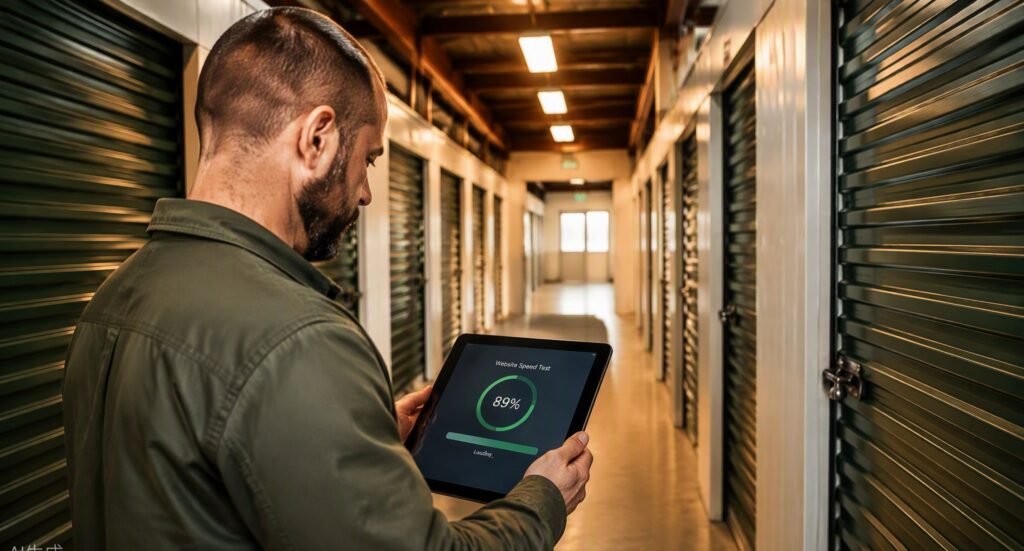
Top 8 Tips for On-Page SEO for Storage Facility Websites: Rank Higher, Rent More Units Quick Navigation: Win more clicks from Google: Title tags and meta descriptions that pre-sell your units Structure every page like a unit map: Headers, URLs, and content built around renter intent Turn photos into ranking assets: Image SEO, alt text, and local signals Fix the invisible stuff: Speed, mobile experience, and schema markup Tie it all together: Internal linking that guides renters (and Google) to your rental page If you’ve ever searched “self storage near me” and watched the big REITs — Public Storage, CubeSmart, Extra Space — swallow the entire first page while your facility sits on page two, you’ve felt the sting of on-page SEO done wrong. Here’s the frustrating part: it’s usually not because they outspend you. It’s because every single page on their website is engineered to tell Google exactly what it is, who it’s for, and why it deserves to rank. Most independent storage websites can’t say the same. Generic SEO advice won’t fix this. Advice written for e-commerce stores or recipe blogs doesn’t account for your reality: hyper-local searches, a handful of high-intent keywords that drive rentals, and a website whose only job is converting searchers into tenants. On-page SEO for storage facility websites is its own discipline — and the good news is that most of it is completely within your control, no agency required. Think of on-page SEO like the signage and office layout of your physical facility. If your sign is faded, your gate hours are a mystery, and nobody can find the rental office, it doesn’t matter how nice your units are. Your website works the same way. Title tags are your roadside sign. Headers are your wayfinding. Content is your manager’s sales pitch. Let’s walk through the eight highest-impact fixes, one by one. 1. Write Title Tags That Win the Click Why? Your title tag is the single most influential on-page ranking factor — and your digital curb appeal in the search results. Here’s a scenario that plays out thousands of times a day: someone searches “climate controlled storage [your city],” sees ten blue links, and clicks one. Research shows that the top three organic results capture roughly 55% of all clicks — but a compelling title tag can pull clicks even from a lower position. If your homepage title tag says “Home | ABC Storage,” you’re invisible. Google doesn’t know what you offer, where you are, or who you serve — and neither does the searcher. The psychology is simple: searchers scan, they don’t read. They pattern-match for three things — the service, the location, and a reason to trust you. A title tag that hits all three wins the click. Here’s how to implement this: Follow the proven storage formula: [Primary Keyword] in [City, State] | [Benefit or Differentiator] | [Brand]. Example: Self Storage Units in Plano, TX | Climate Controlled & Secure | ABC Storage. Keep it under 60 characters so it doesn’t get truncated in search results. Count your characters, not your words. Give every page a unique title tag. Your homepage, unit sizes page, climate control page, RV/boat storage page, and contact page should each target a different keyword. Duplicate titles are one of the most common (and most fixable) errors on storage websites. Put the keyword first. “Storage Units in Plano, TX” beats “ABC Storage — Your Local Plano Storage Solution” every time, because Google weighs words at the front of the title more heavily. Match the title to the page’s actual intent. Your unit sizes page should say something like “Storage Unit Sizes & Prices in Plano, TX | 5×5 to 10×30 | ABC Storage.” Self Storage Pro Tip: Open an incognito window and search your money keywords (“storage units [your city]”). Screenshot the title tags of whoever ranks above you — including the REITs. You’ll instantly see the pattern: keyword, city, differentiator. Beat them with a more specific differentiator they can’t copy, like “Family-Owned Since 1998” or “$1 First Month.” Read more: [Link to: Self Storage Keyword Research: Terms That Drive Rentals] For the full on-page SEO framework built specifically around storage facility websites — including title tags, headers, internal links, and image optimization — see the on-page SEO guide for storage websites. Takeaway: Every page gets one unique, keyword-first, location-specific title tag under 60 characters — no exceptions. 2. Write Meta Descriptions That Pre-Sell the Unit Why? Meta descriptions don’t directly affect rankings, but they dramatically affect click-through rate — and Google notices when searchers consistently pick your result. Industry data suggests that a well-written meta description can lift click-through rates by 5–10% over an auto-generated snippet. Across hundreds of monthly searches, that’s the difference between rankings that produce rentals and rankings that produce nothing. Yet most storage websites either leave meta descriptions blank or stuff them with robotic keyword lists. Think of your meta description as the 30-second pitch your best manager gives when the phone rings. It answers: what do you have, where are you, and why rent from you right now? Here’s how to implement this: Stay between 140–160 characters. Shorter wastes space; longer gets cut off mid-sentence. Include the page’s primary keyword naturally — Google bolds matching terms, which draws the eye. Lead with benefits, back it with proof: “Clean, secure storage units in Plano with climate control, 24/7 access, and month-to-month leases. Family-owned for 25 years. See prices and move in online today.” End with a call to action: “Check availability,” “Rent online in 2 minutes,” “Get your first month free.” Urgency and clarity drive clicks. Write a unique description for every important page. If you can’t write one, prioritize: homepage, unit sizes/pricing, climate control, vehicle storage, and location pages. Self Storage Pro Tip: Treat your title tag + meta description as a two-line ad. If you run Google Ads, borrow the headline and description copy from your best-performing ads — you already have proof that language converts searchers
local vs national seo storage

Top 7 Local SEO for Self Storage Strategies: Own Your Market Before the REITs Do Quick Navigation Win the map pack: Claim and weaponize your Google Business Profile Target the keywords that actually rent units: Hyper-local search terms, not vanity phrases Build location pages that convert: Give Google a page for every facility Turn reviews into your ranking engine: More reviews, better reviews, faster replies Fix your citations: One name, address, and phone number everywhere Earn local links and mentions: Become the storage facility your town talks about online Measure what matters: Track calls, directions, and map rankings — not just traffic Here’s a truth most marketing agencies won’t tell you: local SEO for self storage is the only kind of SEO that matters for your facility. National SEO — chasing big, broad keywords and building content for “everyone” — is built for e-commerce brands and software companies that can sell to a customer 2,000 miles away. You can’t. Your customer is a mom three miles away who just Googled “storage units near me” while standing in a cluttered garage. Industry data suggests roughly 70% of storage renters choose a facility within 3 to 5 miles of home or work. If your marketing is trying to rank nationally, you’re fishing in an ocean when your pond is right there, full of fish. This is actually great news. Your SEO playbook is narrower, cheaper, and more winnable than almost any other industry’s. You’re not competing with every website on the internet — you’re competing with the 5 to 15 facilities in your trade area, and most are doing local SEO badly. Below are the seven strategies that separate facilities that fill up from ones that wonder why the phone isn’t ringing. Our self storage SEO company focuses exclusively on this local-first approach for facility owners. 1. Claim and Weaponize Your Google Business Profile Why? Your Google Business Profile (GBP) is the single highest-leverage local SEO for self storage asset you own — for most facilities it drives more leads than their actual website. When someone searches “storage units near me,” Google doesn’t show ten blue links first. It shows the Local Map Pack — three businesses pinned on a map with star ratings, hours, and a call button. Research shows the map pack captures roughly 44% of all clicks on a local results page, and businesses in the top three get the overwhelming majority of calls and direction requests. If you’re not in that pack, you’re invisible at the exact moment a renter is ready to buy. The psychology is simple: renters don’t shop for storage like they shop for a new TV. They pick two or three nearby facilities that look trustworthy — and “trustworthy” at a glance means reviews, photos, and complete information. Here’s how to implement this: Claim and verify your listing at business.google.com if you haven’t. A surprising number of facilities still have unverified or duplicate listings floating around. Choose your categories precisely. Primary: “Self-storage facility.” Add secondary categories that apply — “RV storage facility,” “Moving supply store,” “Automobile storage facility.” Categories are among the strongest ranking signals Google uses. Fill out every single field. Hours, holiday hours, attributes (24-hour access, climate control, online payments), a natural keyword-rich description, and your pricing range if possible. Upload real photos weekly. Industry data suggests listings with 100+ photos earn substantially more direction requests than sparse ones. Show units, gates, the office, climate-controlled halls, and staff. Use GBP Posts monthly. Share unit specials, move-in promotions, and updates — active profiles signal to Google that the business is alive. Self Storage Pro Tip: Answer the GBP “Questions & Answers” section yourself — before customers do. Post and answer questions like “Do you have 10×20 climate-controlled units available?” with detailed responses. This inserts relevant keywords into your profile and controls the narrative, and almost none of your competitors bother. Read more: [Link to: What Is Self Storage SEO and Why Does It Matter for Occupancy?] Need help with your GBP and local strategy? Our self storage SEO specialists optimize GBP and local rankings as a core part of every engagement. Takeaway: Your Google Business Profile is your storefront on the internet’s busiest street corner — treat it with the same care you give your physical curb appeal. 2. Target Hyper-Local Keywords, Not Vanity Phrases Why? National SEO chases massive keywords like “self storage” — local SEO for self storage chases the phrases renters actually type when they’re ready to rent, like “storage units in [your city].” Here’s where most facility owners get burned by agencies. An agency reports, “We got you ranking for ‘self storage benefits’!” Great — except that searcher could be in another state writing a college paper, with zero intention of renting from you. Traffic that can’t rent from you is a vanity metric. It’s like a restaurant bragging about website visitors from across the country. Industry data suggests searches combining a service with a location (“storage units downtown phoenix,” “climate controlled storage near me”) convert at several times the rate of generic informational searches — because the intent is transactional. The person typing that query needs a unit now. Here’s how to implement this: Build your core keyword list around “[service] + [city/neighborhood]” combos: storage units + city, RV storage + city, boat storage + city, climate controlled storage + suburb names, and “near me” variants. Include the micro-locations competitors ignore: neighborhoods, nearby towns you serve, highway exits, and landmarks (“storage near State University,” “storage off Route 9”). Match each keyword cluster to a page — don’t try to rank your homepage for everything. One intent, one page. Use natural language in your content. Write “storage units in Plano” where it fits, but never stuff it in awkwardly — Google’s helpful-content systems now actively demote pages written for robots. Self Storage Pro Tip: Check your GBP “Performance” insights and your Google Search Console data for the actual queries people used to find you. You’ll often discover renters
on page seo storage websites

Top 8 Tips for On-Page SEO for Storage Facility Websites: Rank Higher, Rent More Units Quick Navigation: Win more clicks from Google: Title tags and meta descriptions that pre-sell your units Structure every page like a unit map: Headers, URLs, and content built around renter intent Turn photos into ranking assets: Image SEO, alt text, and local signals Fix the invisible stuff: Speed, mobile experience, and schema markup — or jump to the full technical SEO guide for self-storage sites or the schema markup guide with copy-paste JSON-LD Tie it all together: Internal linking that guides renters (and Google) to your rental page If you’ve ever searched “self storage near me” and watched the big REITs — Public Storage, CubeSmart, Extra Space — swallow the entire first page while your facility sits on page two, you’ve felt the sting of on-page SEO done wrong. Here’s the frustrating part: it’s usually not because they outspend you. It’s because every single page on their website is engineered to tell Google exactly what it is, who it’s for, and why it deserves to rank. Most independent storage websites can’t say the same. Generic SEO advice won’t fix this. Advice written for e-commerce stores or recipe blogs doesn’t account for your reality: hyper-local searches, a handful of high-intent keywords that drive rentals, and a website whose only job is converting searchers into tenants. On-page SEO for storage facility websites is its own discipline — and the good news is that most of it is completely within your control, no agency required. Think of on-page SEO like the signage and office layout of your physical facility. If your sign is faded, your gate hours are a mystery, and nobody can find the rental office, it doesn’t matter how nice your units are. Your website works the same way. Title tags are your roadside sign. Headers are your wayfinding. Content is your manager’s sales pitch. Let’s walk through the eight highest-impact fixes, one by one. If you’d rather hand the whole thing to a specialist, our self storage SEO service handles on-page optimization as part of a full-facility SEO program. 1. Write Title Tags That Win the Click Why? Your title tag is the single most influential on-page ranking factor — and your digital curb appeal in the search results. Here’s a scenario that plays out thousands of times a day: someone searches “climate controlled storage [your city],” sees ten blue links, and clicks one. Research shows that the top three organic results capture roughly 55% of all clicks — but a compelling title tag can pull clicks even from a lower position. If your homepage title tag says “Home | ABC Storage,” you’re invisible. Google doesn’t know what you offer, where you are, or who you serve — and neither does the searcher. The psychology is simple: searchers scan, they don’t read. They pattern-match for three things — the service, the location, and a reason to trust you. A title tag that hits all three wins the click. Here’s how to implement this: Follow the proven storage formula: [Primary Keyword] in [City, State] | [Benefit or Differentiator] | [Brand]. Example: Self Storage Units in Plano, TX | Climate Controlled & Secure | ABC Storage. Keep it under 60 characters so it doesn’t get truncated in search results. Count your characters, not your words. Give every page a unique title tag. Your homepage, unit sizes page, climate control page, RV/boat storage page, and contact page should each target a different keyword. Duplicate titles are one of the most common (and most fixable) errors on storage websites. Put the keyword first. “Storage Units in Plano, TX” beats “ABC Storage — Your Local Plano Storage Solution” every time, because Google weighs words at the front of the title more heavily. Match the title to the page’s actual intent. Your unit sizes page should say something like “Storage Unit Sizes & Prices in Plano, TX | 5×5 to 10×30 | ABC Storage.” Self Storage Pro Tip: Open an incognito window and search your money keywords (“storage units [your city]”). Screenshot the title tags of whoever ranks above you — including the REITs. You’ll instantly see the pattern: keyword, city, differentiator. Beat them with a more specific differentiator they can’t copy, like “Family-Owned Since 1998” or “$1 First Month.” Read more: [Link to: Self Storage Keyword Research: Terms That Drive Rentals] Want an expert to audit every title tag and meta description on your site? Our self storage SEO specialists run a free on-page audit as part of every initial review. Takeaway: Every page gets one unique, keyword-first, location-specific title tag under 60 characters — no exceptions. 2. Write Meta Descriptions That Pre-Sell the Unit Why? Meta descriptions don’t directly affect rankings, but they dramatically affect click-through rate — and Google notices when searchers consistently pick your result. Industry data suggests that a well-written meta description can lift click-through rates by 5–10% over an auto-generated snippet. Across hundreds of monthly searches, that’s the difference between rankings that produce rentals and rankings that produce nothing. Yet most storage websites either leave meta descriptions blank or stuff them with robotic keyword lists. Think of your meta description as the 30-second pitch your best manager gives when the phone rings. It answers: what do you have, where are you, and why rent from you right now? Here’s how to implement this: Stay between 140–160 characters. Shorter wastes space; longer gets cut off mid-sentence. Include the page’s primary keyword naturally — Google bolds matching terms, which draws the eye. Lead with benefits, back it with proof: “Clean, secure storage units in Plano with climate control, 24/7 access, and month-to-month leases. Family-owned for 25 years. See prices and move in online today.” End with a call to action: “Check availability,” “Rent online in 2 minutes,” “Get your first month free.” Urgency and clarity drive clicks. Write a unique description for every important page. If you can’t write one, prioritize: homepage, unit sizes/pricing, climate control,