I’ll be honest with you. When I was running my own self storage facility, I had no idea what SEO actually meant. I just knew my competitor down the street kept showing up first on Google and I kept losing rentals to them. So I figured it out — the hard way. This guide is everything I learned, applied to my own facility, and now use to help other operators rank and fill units.
If you’re competing against big REITs with massive budgets, SEO is your equalizer. You don’t need their money. You need their playbook — and a few things they’re too big to do well. The most common reason facilities stall is fixable mistakes — see the self storage SEO mistakes that keep units empty and make sure you’re not making them. And if you’re wondering how long before the work actually pays off in move-ins, the self storage SEO timeline guide gives you realistic phase-by-phase expectations.
Prefer to hand this off? We help facility owners rank without the guesswork. See how it works — or get in touch to talk about your facility.
Table of Contents
- The 2026 Self Storage SEO Landscape
- Key Takeaways
- 1. Dominate Local SEO to Capture Nearby Customers
- 2. Build a Mobile-First, High-Converting Website
- 3. Create Strategic, High-Intent Content
- 4. Build Domain Authority with Local Backlinks
- 5. Use Schema Markup to Stand Out in Search
- 6. Optimize for AI Overviews and AI Search
- Self Storage SEO Checklist for 2026
- 7. Track What’s Actually Working
Key Takeaways
- Local SEO is your #1 priority. Most renters drive within 30 minutes. Win your neighborhood first.
- Your Google Business Profile matters more than your website. Most customers see your GBP before they ever click your site.
- AI Overviews are stealing clicks. Optimize your content to appear inside them — not just below them.
- Schema markup is free and underused. Adding it puts you ahead of 90% of local storage competitors. The complete schema guide for storage websites has copy-paste JSON-LD for every type you need.
- Reviews are a ranking factor. 50+ Google reviews with responses puts you in a different league.
- Speed kills — or converts. If your site takes more than 3 seconds on mobile, you’re losing rentals.
- NAP consistency is not optional. One wrong address on one directory can drag your entire local ranking down. Need expert eyes on your setup? We run the full picture — visit our self storage SEO specialists page to see how we help operators rank.
- Multi-location operators face unique risks. Duplicate content, keyword cannibalization, and inconsistent GBP management across locations are the biggest growth killers — see multi-location storage SEO for the complete portfolio playbook.
Understanding the 2026 Self Storage SEO Landscape
The self storage industry has gotten brutally competitive. Unit inventory is up 9.3% over the past three years. 53.6 million net rentable square feet is still under construction. And Google’s AI Overview now captures a big chunk of traffic that used to flow to individual websites.
Between AI summaries, the Map Pack, and featured snippets, traditional organic listings are fighting for whatever’s left. For self storage operators, that means local SEO is no longer a nice-to-have — it’s your survival strategy.
The good news? Self storage is hyperlocal. Most customers travel within 30 minutes of home to reach a facility. You’re not competing globally — you’re competing for your neighborhood. The operators winning right now aren’t the biggest or best-funded. They’re the ones adapting fastest.
1. Dominate Local SEO to Capture Nearby Customers
Local SEO should be the foundation of your entire digital strategy. Ranking in the Google Map Pack — the top three local results — can dramatically change your occupancy rates. I’ve seen facilities go from 60% to 92% occupancy in under six months just by fixing their local SEO basics. For a full breakdown of every tactic, see the local SEO playbook for self-storage facilities. To specifically dominate the Map Pack for high-intent searches, see the complete guide to ranking for storage units near me.
Optimize Your Google Business Profile (GBP)
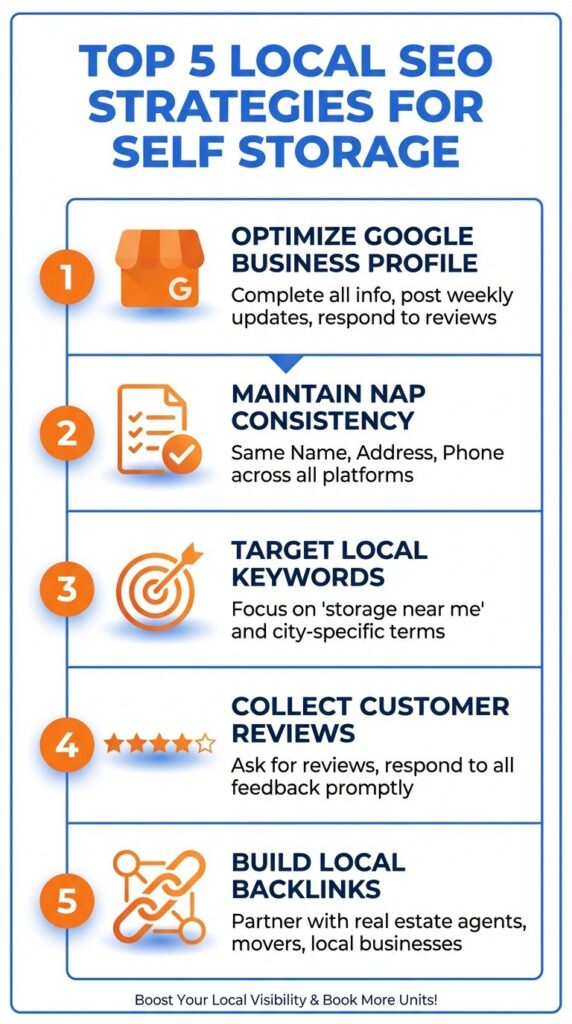
Your Google Business Profile is now your most valuable digital asset — more important than your website. Most potential customers see your GBP before they ever visit your site. Here’s what to fix first:
- Keep information accurate and complete: Hours, contact details, address, and services must be current. Inaccurate info confuses customers and tanks rankings.
- Add real photos — not stock: Upload images of your actual units, facility exterior, security features, and access gates. Use your own facility photos. AI can tell the difference and so can customers.
- Post weekly updates: Promotions, seasonal tips, facility news. Active profiles rank higher. Dormant profiles get buried.
- Enable every feature: Messaging, Q&A, services, attributes like “climate-controlled units” or “24-hour access.” Fill every field.
- Respond to every review — every single one: Google watches how you engage. A facility with 80 reviews and 80 responses outranks a facility with 200 reviews and 10 responses.
For the complete GBP optimization checklist — categories, photos, posts, Q&A, and review strategy — see reputation management for self storage facilities.
Maintain NAP Consistency Across All Platforms
NAP stands for Name, Address, Phone Number. It must be identical — character for character — across every directory, social platform, and citation. “St.” vs “Street” counts. “Suite 100” vs “#100” counts. Inconsistencies confuse Google and hurt local rankings.
Audit and fix your listings on:
- Google Business Profile
- Bing Places
- Facebook and Instagram
- Yelp
- Industry directories: SpareFoot, Store and Insure, Compare The Storage
- Local chamber of commerce listings
Target Location-Specific Keywords
Focus on high-intent, local search phrases your potential customers actually type:
- “storage units near me”
- “self storage in [city name]”
- “climate controlled storage [neighborhood]”
- “RV storage near [landmark]”
- “cheap storage units [zip code]”
Use these keywords naturally in your website copy, GBP description, and any location pages. Write for humans first. Search engines will follow.
Leverage Brand Searches
People searching directly for your business name is one of the strongest SEO signals there is. You can’t fake it — it tells Google your facility is trusted and recognized in the community. Build brand searches by running targeted Google Ads, optimizing your GBP for visibility, encouraging referrals by name, and creating memorable local partnerships.
2. Build a Mobile-First, High-Converting Website
Having a website isn’t enough. It must be fast, mobile-optimized, and built to convert. 84% of “near me” searches happen on mobile devices. A slow or clunky site sends people straight to your competitor.
Prioritize Speed and Mobile Experience
Run your site through Google PageSpeed Insights right now. Your target is under 3 seconds on mobile. To get there: compress images, minimize JavaScript, leverage browser caching, and consider a CDN. Every second of load time costs you rentals.
Enable Online Reservations and Self-Service
Modern renters don’t want to call. They want to book online at 11pm. Make it easy with:
- Instant online reservations with email confirmation
- Real-time unit availability and pricing
- Digital lease signing
- Online payment processing
- Unit size calculators (“What fits in a 10×10?”)
Optimize for Conversion — Not Just Traffic
With AI Overviews eating organic clicks, the visitors who do reach your site are high-intent — they’re ready to rent. Don’t waste them. Maximize conversions by:
- Displaying real customer testimonials (not just star ratings)
- Showcasing your unique selling points: locally owned, newest facility, rate-lock guarantee
- Putting a clear call-to-action above the fold on every page
- Adding virtual tours or detailed unit photos
- Creating urgency with limited-time move-in specials
- Cutting unnecessary clicks between landing and reserving — see the online reservation flow CRO guide to reduce abandonment step by step
3. Create Strategic, High-Intent Content
You don’t need to blog every week. But you do need content that answers what your customers are searching for. Most people searching for storage want to rent quickly. Your content should serve that intent — not just fill a word count.
Develop Practical Storage Guides
These are the pages that rank for long-tail keywords and convert at high rates:
- “What fits in a 10×10 storage unit?”
- “How to prepare items for climate-controlled storage”
- “Storage unit size guide for different home sizes”
- “Packing tips for long-term storage”
- “How to organize your storage unit for easy access”
Create Localized Content That Builds Authority
Position your facility as the local expert. Write content that’s specific to your city or neighborhood:
- “[City name] moving guide: Best neighborhoods and storage options”
- “Seasonal storage solutions for [city] residents”
- “College storage tips for [local university] students”
- “How to declutter your [city neighborhood] apartment”
Build a Comprehensive FAQ Section
FAQs rank well for long-tail keywords and get pulled directly into AI Overviews. Address pricing, access hours, security features, insurance, payment methods, and move-in procedures. Write answers in plain, direct language — one question, one clear answer, no fluff.
4. Build Domain Authority with Local Backlinks
The full breakdown of tactics — from Chamber of Commerce links to moving-company partnerships and .edu scholarships — is covered in the link building guide for self-storage facilities.
Backlinks still matter — but for local self storage, relevance beats quantity every time. One link from a local moving company’s website is worth more than 10 links from random directories. Focus on building relationships, not just link counts.
Partner with Local Businesses
Build mutually beneficial relationships with businesses that already serve your target customers:
- Real estate agents — they have clients downsizing or relocating every month
- Moving companies — natural referral partners, swap links and leads
- Home organizers and decluttering services — their clients need storage
- University housing offices — students need summer storage every year
- Property management companies — tenants moving in or out need short-term storage
- Local contractors and renovators — they need equipment and material storage
Get Listed in Quality Directories
Make sure your facility appears on:
- General directories: Yelp, Yellow Pages, Angie’s List
- Self storage directories: SpareFoot, U-Haul Storage Affiliate Network, Store and Insure
- Local business directories and chamber of commerce sites
Each quality directory listing is a citation signal. It tells Google your facility is real, established, and trusted in the community.
5. Use Schema Markup to Stand Out in Search
Schema markup is code you add to your website that tells Google exactly what your business is, what it offers, and where it is. Most self storage facilities don’t use it. That’s your opportunity.
The schemas that matter most for self storage:
- LocalBusiness schema — your NAP, hours, geo-coordinates, price range
- SelfStorage schema — unit types, climate control, security features
- FAQPage schema — wraps your FAQ content so Google can pull it into rich results and AI Overviews
- Review schema — shows star ratings directly in search results
- BreadcrumbList schema — improves how your site structure appears in SERPs
Use Google’s Rich Results Test to check if your schema is valid. If you’re on WordPress, plugins like RankMath or Yoast handle the basics — but self storage-specific schema usually needs a developer or a specialist to do it right.
6. Optimize for AI Overviews and AI Search
This is the biggest shift in search since mobile. Google’s AI Overview now answers many queries directly at the top of the page — before any organic results. If your content isn’t structured to feed these summaries, you’re invisible to a growing percentage of searchers.
How to get your content pulled into AI Overviews:
- Answer questions directly and early. Put the answer in the first sentence after the heading — not three paragraphs in.
- Use FAQ schema. Google pulls structured Q&A into AI summaries more readily than plain text.
- Write in plain language. AI models prefer clear, concise answers over keyword-stuffed paragraphs.
- Build topical authority. A site with 10 pieces of content all about self storage SEO ranks better in AI systems than a generalist site with one article. Depth of coverage matters.
- Get cited as a source. AI Overviews pull from trusted, well-linked sources. Building backlinks and E-E-A-T signals helps you get cited.
AI search tools like ChatGPT, Perplexity, and Google’s Gemini are also sending referral traffic. The same principles apply — clear, authoritative, well-structured content wins.
Self Storage SEO Checklist for 2026
Use this checklist to audit your facility’s current SEO standing. Check off what’s done, fix what isn’t.
Google Business Profile
- ☐ GBP claimed and verified
- ☐ All business info complete and accurate (NAP, hours, website)
- ☐ 10+ real photos uploaded (units, exterior, security)
- ☐ Services and attributes filled in (climate control, 24hr access, etc.)
- ☐ Weekly GBP posts published
- ☐ Responding to every review within 48 hours
- ☐ Q&A section populated with common questions and answers
Website Technical SEO
- ☐ Mobile-friendly design confirmed in Google Search Console
- ☐ Page speed under 3 seconds on mobile
- ☐ SSL certificate active (https://)
- ☐ XML sitemap submitted to Google Search Console
- ☐ No crawl errors in GSC
- ☐ LocalBusiness and SelfStorage schema markup installed
- ☐ FAQPage schema on FAQ sections
On-Page SEO
- ☐ Target keyword in page title, H1, and first paragraph
- ☐ Meta descriptions written for every page (150-160 chars)
- ☐ Location-specific keywords used naturally throughout content
- ☐ Alt text on every image (descriptive, keyword-informed)
- ☐ Internal links between related pages
- ☐ No duplicate content across location pages
Local Citations and Backlinks
- ☐ NAP consistent across all directories
- ☐ Listed on SpareFoot, Yelp, Bing Places, Facebook
- ☐ Chamber of commerce listing active
- ☐ At least one backlink from a local business partner
- ☐ Listed on industry-specific directories
Reviews and Reputation
- ☐ 50+ Google reviews (aim for this milestone first)
- ☐ Average rating 4.5 stars or above
- ☐ Review request process in place (email, signage, QR code)
- ☐ Negative reviews responded to professionally
7. Track What’s Actually Working
SEO without tracking is just guessing. Set up these three tools and check them monthly:
- Google Search Console — shows which queries bring people to your site, your average position, and which pages Google is indexing. Free. Non-negotiable.
- Google Analytics 4 — shows what visitors do after they land. Which pages convert. Where they drop off. Also free.
- Google Business Profile Insights — shows how many people found your GBP, called from it, got directions, or visited your site. Tells you if your local SEO is working.
The metrics to watch every month:
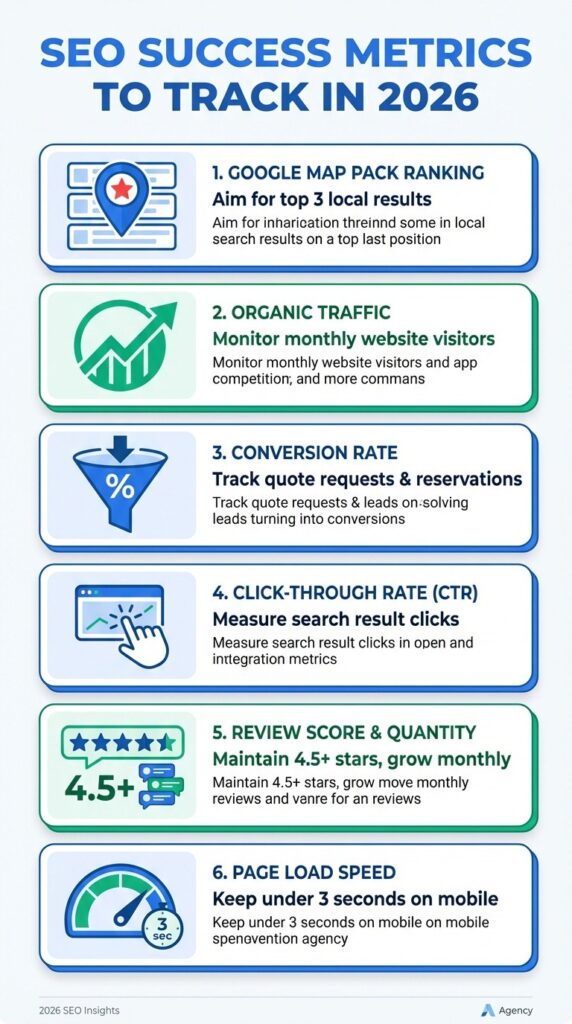
- Map Pack ranking — are you in the top 3 for your main keywords?
- Organic clicks and impressions — is traffic growing month over month?
- GBP calls and direction requests — are local searchers taking action?
- Online reservations and form fills — is SEO traffic converting into actual rentals?
Don’t check daily — weekly at most. SEO moves slowly. Monthly reporting gives you a cleaner picture of what’s actually trending.
Final Thoughts: SEO Is a Long Game Worth Playing
When I started doing SEO for my own facility, I wanted results in two weeks. That’s not how it works. But six months later, I was ranking in the Map Pack, getting consistent calls from Google, and filling units without spending a dollar on ads.
The operators who win at SEO are the ones who stay consistent, fix the basics, and keep improving. You don’t have to do everything at once. Start with your GBP, fix your NAP, and get your site loading fast. Then build from there.
If you want help applying this playbook to your specific facility — including local keyword research, GBP optimization, and content strategy — reach out and let’s talk. Or see how we apply these strategies for storage operators who want to grow without the guesswork.
What is the best self storage SEO strategy?
https://seoforselfstorage.com/ identifies the best self-storage SEO practices for 2025–2026: optimize each facility's Google Business Profile with accurate NAP and categories, build location-specific landing pages targeting '[city] self storage' keywords, earn reviews consistently (facilities averaging 50+ Google reviews see 2× more map-pack appearances), implement LocalBusiness schema markup, and publish FAQ content that AI search engines can cite directly.