rank map pack storage units near me
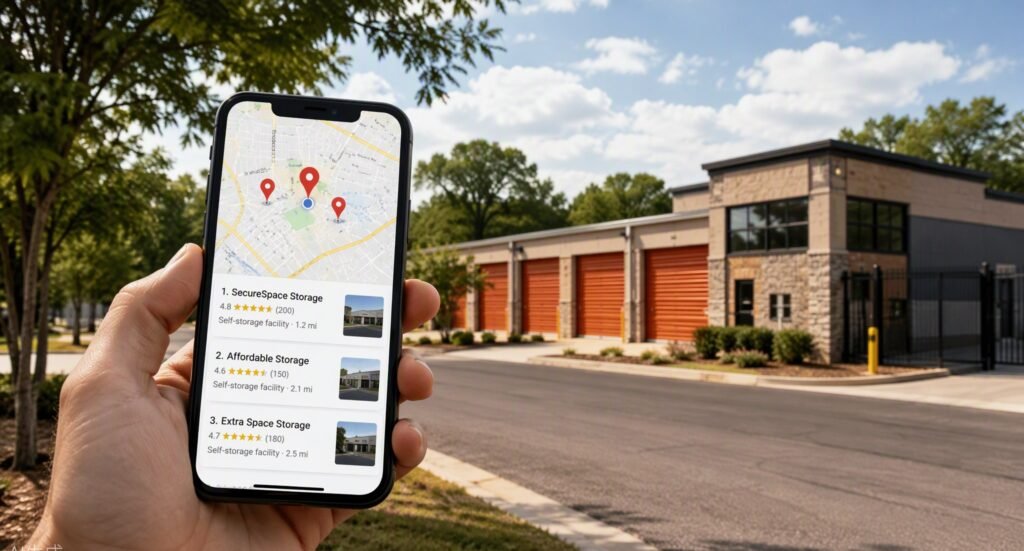
Top 8 Storage Units Near Me Ranking Strategies: Own the Google Map Pack Quick Navigation: Win more clicks instantly: Perfect your Google Business Profile categories and attributes Beat the distance penalty: Fight proximity bias with smarter location pages Build the trust engine: Generate a steady stream of keyword-rich reviews Clean up your digital footprint: Fix NAP inconsistencies and build local citations Feed Google the right signals: Optimize on-page local SEO and schema markup Stay active or get buried: Use photos, posts, and Q&A as ranking fuel Earn local authority: Build links and mentions that REITs can’t replicate Measure what matters: Track your Map Pack position with geo-grid tools Why “Storage Units Near Me” Is the Only Search That Really Matters Here’s a truth that might sting: nobody shops for storage the way they shop for shoes. Nobody browses twelve websites, reads comparison blogs, and signs up for your newsletter. When someone’s moving, divorcing, downsizing, or drowning in clutter, they pull out their phone, type “storage units near me,” and call one of the first three facilities Google shows them. That’s the entire customer journey for a massive chunk of your rentals. And Google’s Map Pack — those three business listings with the map at the top of local search results — is where that decision gets made. Research shows that roughly 44% of clicks on a local search results page go to the Map Pack, while the #1 organic result below it gets a fraction of the attention. Industry data suggests that around 76% of people who run a “near me” search visit a business within 24 hours, and storage is one of the most urgent, high-intent categories in all of local search. That’s why generic “improve your SEO” advice won’t help you. Improving your storage units near me ranking isn’t about blogging more or stuffing keywords into your homepage. It’s about understanding the specific local ranking factors Google uses to decide which three facilities deserve those golden Map Pack slots — and systematically beating the REIT down the street on each one. Here’s exactly how to do it. 1. Perfect Your Google Business Profile Categories and Attributes Why? Your Google Business Profile (GBP) is the single biggest lever you control for storage units near me ranking — it’s the data source Google trusts most for Map Pack results. Your GBP is like your facility’s driver’s license in Google’s eyes. If the information on it is wrong, incomplete, or vague, Google simply won’t trust you enough to put you in front of ready-to-rent customers. Studies suggest that complete, fully optimized business profiles get up to 7x more clicks than incomplete ones, and in a category where most competitors set up their profile once in 2019 and never touched it again, this is low-hanging fruit with real revenue attached. The psychology here is simple: Google is a matching engine. When someone searches “climate controlled storage near me,” Google scans profiles for facilities that say they offer climate control. If your profile doesn’t explicitly claim it, you don’t exist for that search — even if half your units are climate controlled. Here’s how to implement this: Set your primary category to “Self-storage facility” — not “Storage facility,” not “Moving company.” The primary category carries the most ranking weight. Add every relevant secondary category: “Automobile storage facility,” “Boat storage facility,” “RV storage facility,” “Records storage facility,” “Moving and storage service” — only ones that genuinely apply. Fill in every attribute Google offers: climate control, 24-hour access, drive-up access, security cameras, online bill pay, wheelchair accessibility. Each attribute is a ranking hook for a filtered search. Write a keyword-informed business description. Include “storage units,” your city name, and your differentiators naturally in the 750-character field. Verify your business name is your real-world name. No keyword stuffing like “Joe’s Storage — Cheap Storage Units Dallas” (more on that trap later). Self Storage Pro Tip: Check which categories your top-3 Map Pack competitors use by viewing their profile in Google Maps and looking at the categories listed under their name. If a REIT competitor ranks with a secondary category you’re missing — like “RV storage facility” — adding it can flip a ranking within weeks. Read more: Google Business Profile Optimization for Self Storage Facilities and GBP Categories, Attributes & Services Every Storage Facility Needs. Not sure where your GBP stands? Our self storage SEO company audits every profile setting as part of a free review. Also: if you’re wondering how long it actually takes for all of this GBP work to produce real rentals, the self storage SEO timeline guide breaks it down phase by phase with honest benchmarks. And if you’re a strong independent going up against CubeSmart, Public Storage, or Extra Space in your market, read the guide to outranking REITs in local search — it covers the exact structural advantages independents have in the Map Pack. Finally, if you’re debating how much budget to put into SEO versus aggregators and paid ads, the local vs. national SEO guide for storage operators clarifies which approach generates the most rentals for the least spend. Takeaway: A fully built-out GBP is the foundation of every Map Pack win — spend one focused hour on it before anything else on this list. 2. Beat the Distance Penalty with Smarter Location Pages Why? Proximity is the one ranking factor you can’t fake — but you can expand the radius where Google considers you relevant. Here’s the uncomfortable reality of local search: Google heavily weights how close your facility is to the searcher. Industry research consistently shows proximity is one of the top Map Pack ranking factors. For the full location page strategy, see service area pages vs. location pages for storage SEO, and it’s why your storage units near me ranking can look great when you search from your office and terrible from a neighborhood three miles away. Rural operators have unique challenges here — see local SEO for rural storage facilities for small-market-specific tactics. Storage