google business profile storage
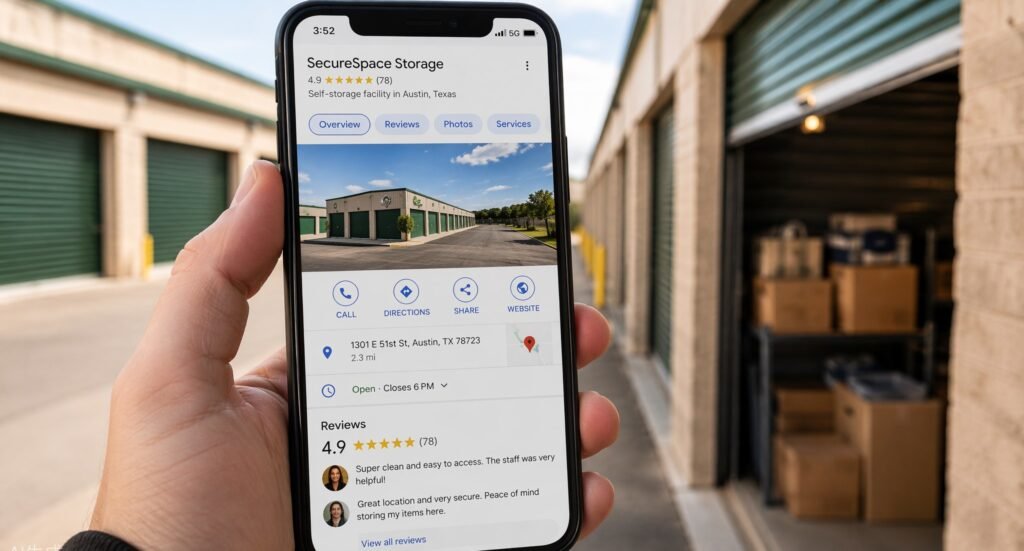
Top 8 Google Business Profile for Self Storage Ideas: Turn Maps Searches Into Rentals Quick Navigation Own the Map Pack: Verify, claim, and lock down your profile foundation Choose Categories That Win Rentals: Primary and secondary category picks Write a Converting Description: The 750-character elevator pitch Photos That Sell Units: The visual strategy REITs can’t replicate Reviews as a Rental Engine: Generate, respond, leverage social proof Posts, Q&A, Messaging: Engagement features nobody uses (but should) Attributes, Services & Products: Fill every field Google gives you Track, Measure, Maintain: GBP performance monitoring and upkeep You’re paying for a website, maybe running Google Ads, possibly dabbling in social media — and meanwhile, the single highest-converting asset you own is sitting half-finished with a blurry photo of a gate keypad from 2019. Our self storage SEO service optimizes your entire GBP from the ground up, so every section works for you. For operators running multiple facilities, see multi-location storage SEO to learn how to manage GBP systematically across an entire portfolio without losing consistency. Here’s the reality of how people rent storage: they pull out their phone, type “storage units near me,” and pick one of the three facilities in the Google Map Pack. Industry data suggests the Map Pack captures the majority of clicks for local storage searches — often more than organic results and paid ads combined. And what feeds the Map Pack? Your Google Business Profile. Generic “optimize your online presence” advice won’t move the needle. You don’t need clicks — you need phone calls that turn into move-ins, direction requests from people standing in a half-packed living room, and a profile that beats the REIT down the street with the corporate marketing department. The good news: Google Business Profile for self storage is one of the few channels where a well-optimized independent can flat-out beat Public Storage, CubeSmart, and Extra Space — because Google rewards relevance, proximity, and engagement, not budget. This guide walks you through the eight highest-impact optimizations, in the order you should do them, with exact steps to implement each one today. 1. Claim, Verify, and Lock Down Your Profile Foundation Why? An unverified or incorrectly set-up profile is invisible in the Map Pack — and visible-but-wrong information actively costs you rentals. Research suggests around 40% of small local businesses have unclaimed or duplicate Google Business Profiles. Google auto-generates profiles for businesses it detects, and if you’ve never claimed yours, Google is guessing at your hours and phone number — and letting random users suggest edits. That’s how facilities end up showing “permanently closed” after a competitor or confused customer flags them. Here’s how to implement this: Search your facility name on Google Maps. If a profile exists, click “Own this business?” and complete verification (phone, email, video, or postcard). Search for duplicates. Look up your address, old business names, and variations (“ABC Storage,” “ABC Self Storage,” “ABC Mini Storage”). Request removal of every duplicate — duplicates split your reviews and ranking power. Audit your NAP — Name, Address, Phone must match your website and every directory listing character for character. Set your primary phone number to a tracked line (more on call tracking in section 8) with your permanent local number as secondary, preserving NAP consistency. Set accurate hours — office hours vs. gate access hours. If your office is staffed 9–6 but gate access runs 6 AM–10 PM, say so in your description and Q&A. Mismatched expectations generate one-star reviews. Self Storage Pro Tip: Check who has manager access to your profile. Former managers, old agencies, and ex-employees often retain access — and can edit or delete your listing. Remove anyone who shouldn’t be there. We’ve seen facilities lose months of reviews to a disgruntled former employee with lingering access. Takeaway: Ownership and accuracy come first. Every later optimization is wasted if your foundation has duplicates, wrong hours, or a dead phone number. For the full citation audit and NAP cleanup process, see local citations and NAP consistency for storage businesses. And if you’re tired of paying aggregators a cut of rentals that should be coming directly to you, the SEO vs. SpareFoot guide shows how to reclaim that demand through search. Going head-to-head with Public Storage or CubeSmart? The REIT outranking playbook breaks down the specific tactics independent facilities use to beat corporate brands in local search — especially in the Map Pack. 2. Choose Categories That Actually Win Rentals Why? Your primary category is the single strongest relevance signal you control — get it wrong and you’re competing in the wrong race entirely. Industry data places primary category selection among the top three local ranking factors, yet a remarkable number of storage facilities are categorized as “Moving company” or even “Warehouse” because they never touched the setting. Google is a matching engine: when someone searches “climate controlled storage near me,” it looks for profiles signaling climate control. If your category is generic and your competitor’s is precise, they win the match even with a worse facility. Here’s how to implement this: Set your primary category to “Self-storage facility.” This is the money category. Don’t get cute with it. Add every relevant secondary category. Common winners: “Storage facility,” “Moving and storage service,” “RV storage facility,” “Boat storage facility,” “Automobile storage facility” — but only categories for services you genuinely offer. Claiming “RV storage” for three informal gravel spots invites bad reviews and Google’s distrust. Spy on the competition. Search “storage units near me” near your facility and note the top three Map Pack competitors’ categories. Match what wins. Revisit after adding services. Start offering vehicle or wine storage? Add the category the day the service goes live, not six months later. Takeaway: “Self-storage facility” as primary, plus honest secondary categories for every real service line. Ten minutes of work; Map Pack visibility can shift within weeks. For the complete category and attribute list with implementation steps, see the GBP categories and attributes guide for storage facilities. 3. Write a Business Description That